For the uninitiated, the Take Along Tunes toy plays a series of excerpts from Classical- and Baroque-era (mostly) orchestral works while flashing colored lights; its purpose is to distract and occupy your baby while you’re forcing them to do something they don’t particularly enjoy (in our case, diaper changes). As musical toys go, it’s really not annoying, because the tunes are pleasant and the excerpts are long enough not to drive you up the wall with repetitiveness.
While there are some obvious, Greatest-Hits-of-the-Classical-Era-type selections (William Tell, Eine Kleine Nachtmusik), some other excerpts stumped me.
Step 1: Google.
I tried simply searching the internet for av list of songs, and I was able to find a review of the toy that appeared to have answered this question for me:
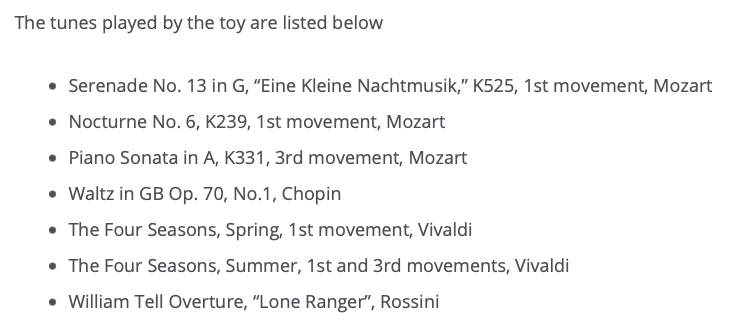
A number of these were correct—all the Mozart selections, the Chopin, the Rossini, and Vivaldi “Spring”—but I listened to all of “Summer” and didn’t hear anything from the toy, and about four tunes were left unidentified.
Have a listen to these mystery tunes and feel yourself being transported to your last drop-the-needle test.
I then tried entering the unidentified melodies into things like Shazam and ThemeFinder.org, to no avail.
Thus began my wild goose chase.
Step 2: Musicology Twitter.
Clearly I needed to tap a bigger network, so it was time to bring in Twitter.
I was encouraged when, after less than 20 minutes, a hero identified two of the four tunes as some real deep cuts.

(at the risk of exposing an embarrassing lack of knowledge about a composer I once considered writing my dissertation on…)
wtf is a Goldberg canon!?
Apparently they were only discovered in 1975. Weird choice for a baby toy, right? Here’s an edition of the Goldberg canons on IMSLP—the toy plays #5 with some small alterations.
Vivaldi wrote so much stuff that I’m not surprised I couldn’t identify this violin concerto. We are very far out of my wheelhouse with this one.
But no one was able to tackle Mystery Tunes A and D yet.
Step 3: Ask nerdy friends.
As a result of being a music professor and obtaining a PhD in music geekery, I know a lot of people who seem to know everything about Classical music. I contacted some of my most savvy friends from CUNY—no IDs, although one friend suggested that D was “bad Handel” and that A had mode mixture that was “a Brahms or Dvořák thing, or like Berlioz.”
Then I even asked my former professor Bill Rothstein, who I suspect has a photographic memory and seems to be able to sit down at the piano and immediately play any piece you mention from memory—still nothing!
At this point I started to fear that I’d never know the answer to this mystery.
Step 4: Back to Twitter.
I went back to Twitter to beg and plead for my followers’ help. I even tried appealing to people’s egos by mentioning they’d be out-guessing Bill Rothstein if they knew any of the answers. Yet no one answered my calls. Inspired by the suggestion that Mystery Tune D was “bad Handel,” I decided to tag in Handel scholar Greg Decker. In a surprise twist ending, though, it was Mystery Tune A that Greg was able to identify!
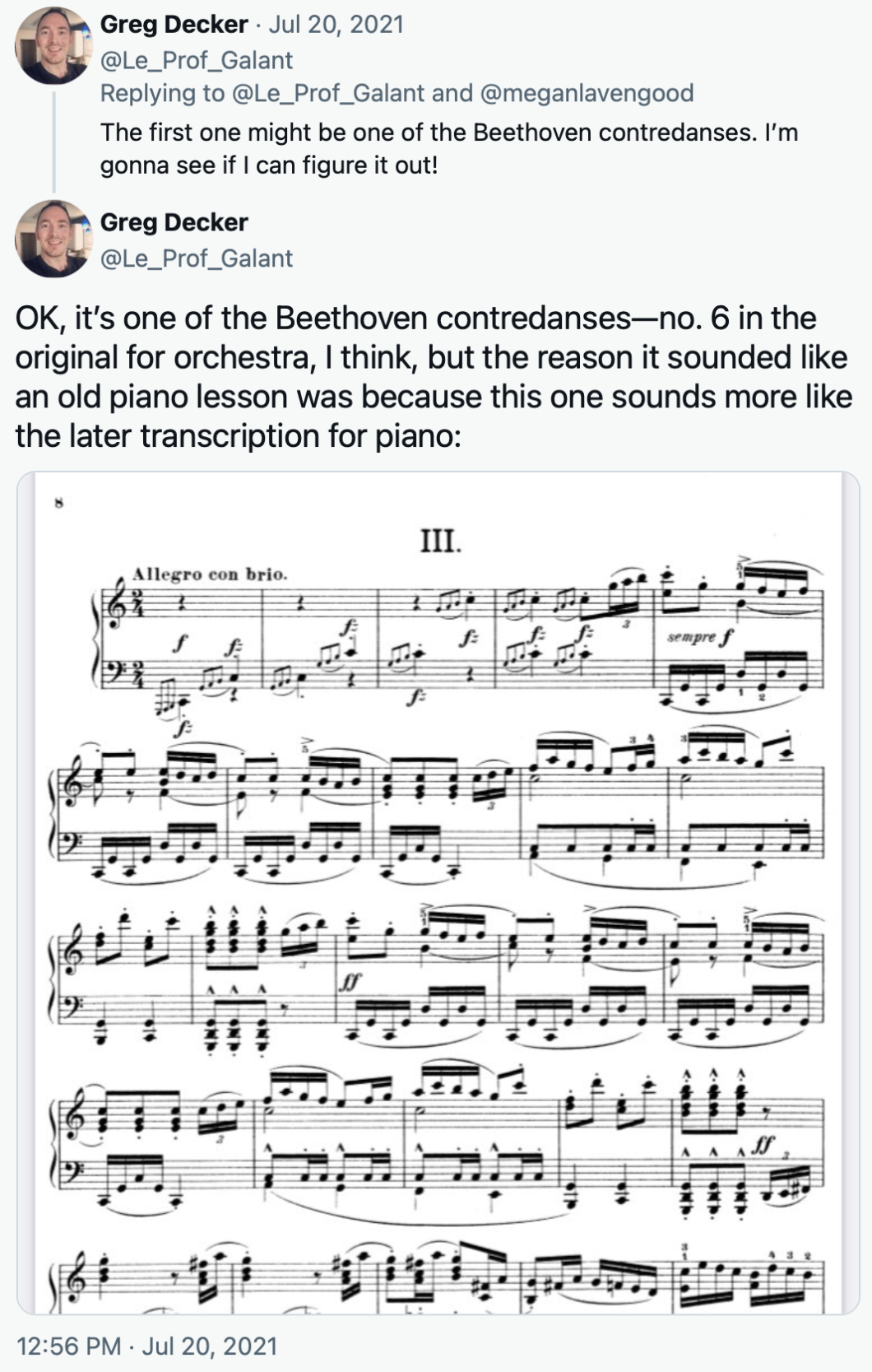
Music Theory Twitter begged Greg to work his magic on Mystery Tune D as well. He did admit it “could be Handel” but said he was too busy for the time being to go on a scavenger hunt. (I mean, come on, though, what could be more important?)
But another surprise came when the final piece was identified by a theory professor whose expertise came not from their extensive schooling, but instead from their extensive family.
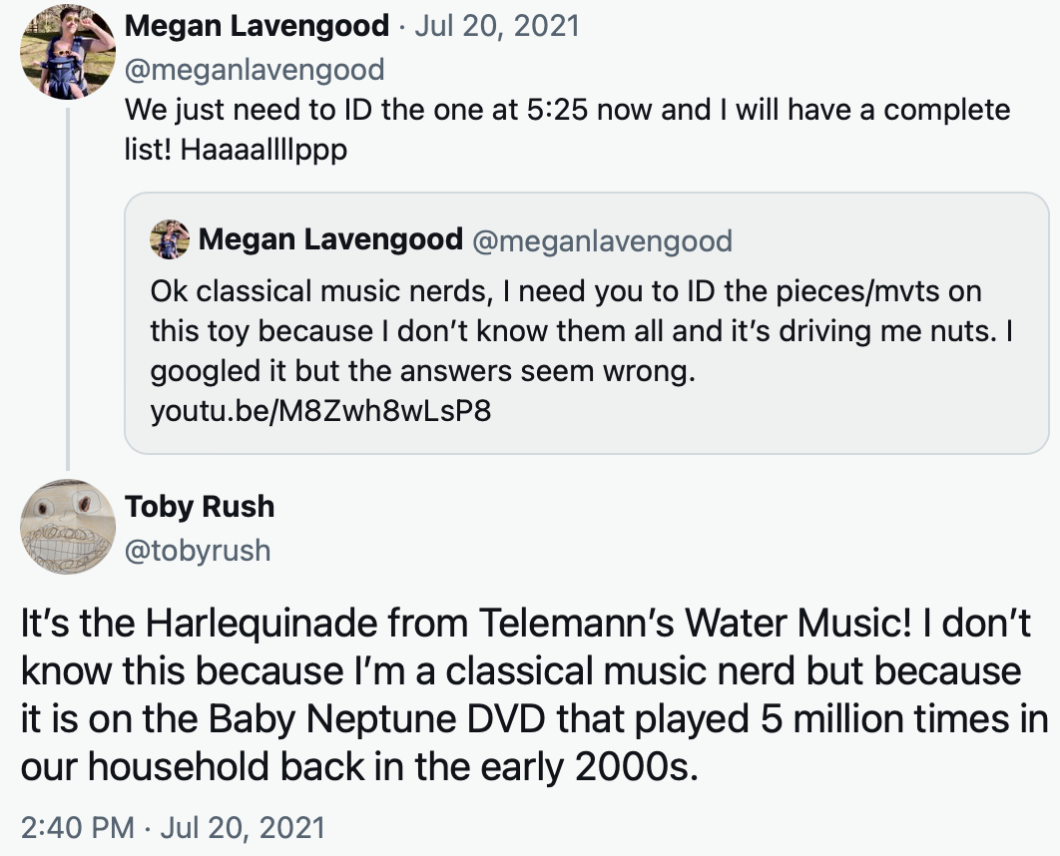
So it turns out “bad Handel” and “early 18th-c.” were both pretty good inferences.
The Complete List of Songs in the Take Along Tunes toy
Here is the actual list of pieces featured in the Baby Einstein Take Along Tunes toy and a Spotify playlist I’ve assembled for your (and my) listening pleasure.
| Composer | Piece and IMSLP link |
|---|---|
| Ludwig van Beethoven | 12 Contradanses, WoO 14, No. 6* |
| Wolfgang Mozart | Serenade in D major, K. 239, mvt. I |
| Frédéric Chopin | Waltz, Op. 70, No. 1 |
| Johann Sebastian Bach | 14 Canons, BWV 1087, No. 5 |
| Antonio Vivaldi | Violin Concerto in E, Op. 3, No. 12 |
| Gioachino Rossini | Overture from William Tell |
| Wolfgang Mozart | Piano Sonata in A major, K. 331, mvt. III |
| Antonio Vivaldi | Violin Concerto in E, “Spring”, mvt. I |
| Georg Philipp Telemann | Ouverture-Suite TWV 55:C3, mvt. VI |
| Wolfgang Mozart | Eine kleine Nachtmusik, K. 525, mvt. I |
* From the comments on the original post, John D. Wilson added: “The piano arrangement of the contredanse actually conflates No. 6 and No. 10 (also in C major). The mode mixture your friend described as Dvořák-esque was also an added flourish by the arranger, Isidor Seiss.”