<?xml version="1.0" encoding="utf-8"?><feed xmlns="http://www.w3.org/2005/Atom" ><generator uri="https://jekyllrb.com/" version="4.4.1">Jekyll</generator><link href="https://meganlavengood.com/feed.xml" rel="self" type="application/atom+xml" /><link href="https://meganlavengood.com/" rel="alternate" type="text/html" /><updated>2026-03-23T21:14:49+00:00</updated><id>https://meganlavengood.com/feed.xml</id><title type="html">Megan L. Lavengood</title><subtitle>Personal website for Megan Lavengood, music theorist.</subtitle><author><name>Dr. Megan L. Lavengood</name></author><entry><title type="html">The Yamaha DX7 in Synthesizer History</title><link href="https://meganlavengood.com/2022/05/12/the-yamaha-dx7-in-synthesizer-history/" rel="alternate" type="text/html" title="The Yamaha DX7 in Synthesizer History" /><published>2022-05-12T15:26:37+00:00</published><updated>2022-05-12T15:26:37+00:00</updated><id>https://meganlavengood.com/2022/05/12/the-yamaha-dx7-in-synthesizer-history</id><content type="html" xml:base="https://meganlavengood.com/2022/05/12/the-yamaha-dx7-in-synthesizer-history/"><![CDATA[<p>My focus on the Yamaha DX7 synthesizer may seem overly niche or specialized, but in this essay I establish the magnitude of this synthesizer’s impact on popular music in the 1980s. While the average person is unaware of the synthesizer by name, the DX7 changed popular music as we know it today. To say that the DX7’s arrival was earth-shaking would be no exaggeration: the affordable price, sound palette, and physical feel of the instrument combined to make the DX7 the new must-have instrument in every studio, garage, and university music department in the U.S. and the U.K. My study of contemporaneous music periodicals has led me to construct a narrative that describes how the DX7 impacted the lives of working musicians in the U.S. and the U.K. in the 1980s.</p>

<h2 id="introduction">Introduction</h2>

<p>The sonic landscape of popular music included keyboards long before the 1980s. Along with the piano, the standby keyboard instrument in the pop world, keyboardists might often play electric pianos such as the Fender Rhodes, the Hohner Pianet, the Wurlizer electric piano, or the distinctive Hohner Clavinet, or electric organs such as the Hammond B3 or the Vox Continental. A handful of keyboard legends emerge in popular music during the 1950s and ’60s—Little Richard, Stevie Wonder, Ray Manzarek, and Keith Emerson, to name a few—but prior to the 1970s, the role of the keyboardist was, generally speaking, relegated to a rhythm section role, rather than being featured as a solo instrument. In other words, while guitar heroes like Jimi Hendrix, Eric Clapton, and Keith Richards enraptured audiences with epic guitar solos, keyboardists typically remained out of the spotlight. The amplified and distorted guitar was able to produce loud, sustained sounds, which were simply better suited to virtuosic and crowd-pleasing solos. In those early decades, the keyboard instruments were no match.</p>

<p>The Moog modular analog synthesizer, developed in the early 1960s, was the first synth that rivaled the power of the electric guitar in volume and timbre. The Moog is an analog modular synthesizer, meaning that the sounds were generated from a sound wave oscillator—a physical (analog) device, controlled, in a physical sense, by voltage. To produce different sounds on the Moog, one needed different modules that would further generate or modify sounds. Sounds were created using quarter-inch cables to “patch” modules together (this is the etymology of the term “patch,” which today refers to any sound or preset on a synthesizer). The resulting collection of modules was typically bigger than the keyboard itself. The size alone meant the Moog could not be taken on the road: this early synthesizer, not unlike the early computers, was a massive device that was prohibitively expensive for most musicians.</p>

<p>The invention of the Minimoog resolved the size issue, and made the price more affordable. Introduced in 1970, the Minimoog was capable of producing a similarly powerful analog sound without needing the bulky modules. The Minimoog had limitations, being a monophonic synthesizer; ironically, these limitations actually led to the liberation of the keyboardist from the background. The Minimoog was not functional as a pad (i.e., sustained, harmonic background) or rhythm instrument like older organs and pianos, but it excelled at the indulgent, virtuosic, monophonic solos that had previously been the exclusive purview of the electric guitars.<sup id="fnref:1"><a href="#fn:1" class="footnote" rel="footnote" role="doc-noteref">1</a></sup> The Minimoog firmly established synthesizers as an important musical instrument within pop and rock music.<sup id="fnref:2"><a href="#fn:2" class="footnote" rel="footnote" role="doc-noteref">2</a></sup> The synthesizer rapidly became cool, and moreover, became synonymous with futuristic technology—a signification with important implications for aesthetics in 1980s pop music, which frequently used themes of futurism.</p>

<blockquote>
  <p>[The DX7] is such a great instrument, such a versatile instrument. I think we’re still at the tip of the iceberg of what it’s capable of.</p>

  <p class="figcaption">Patrice Rushen</p>
</blockquote>

<h2 id="the-arrival-of-the-dx7">The Arrival of the DX7</h2>

<p>A handful of synthesizers dominated the sound of the 1980s. The Roland Jupiter-8, released in 1981, was one of these. The Jupiter-8 is an analog synthesizer so immensely powerful that it can seem like the teleological goal of all prior analog synthesizer development. The Jupiter-8 is responsible for many iconic ’80s sounds, including Michael Jackson’s “Thriller” (recorded in 1982) and music for the movie <em>The NeverEnding Story</em> (1984).</p>

<p>Analog synthesis never really disappeared from the sound of popular music, but most other quintessential ’80s synthesizers introduced the listening public to other, newer methods of sound synthesis, all of which were made possible by digital computing and microprocessors. The Fairlight CMI, first released in 1979, and the E-MU Emulator, first released in 1981, are two of the first keyboards to use digital sampling. Sampling made any sound imaginable available to keyboardists—or at least, to keyboardists who could afford them. Both the Fairlight and the Emulator were prohibitively expensive for the average keyboardist, with list prices in the tens of thousands of dollars at their release (1979 and 1981, respectively). Successful artists like Kate Bush and Duran Duran, who were able to pay for studio time and access to them, used these instruments to bring an entirely new flavor to their music. Even while samplers were out of the reach of many musicians, they left a major mark on the music of the 1980s.<sup id="fnref:3"><a href="#fn:3" class="footnote" rel="footnote" role="doc-noteref">3</a></sup></p>

<p>Also new in the 1980s was wavetable synthesis, famously deployed in the PPG Wave synthesizers. The PPG Wave processes analog waveforms through the digital microprocessors to produce new, more dynamic sounds. Both sampling and wavetable synthesis represent a merging of analog and digital technologies: the source of the sound is an analog source—a recorded analog sample in the case of the sampler, and an analog waveform in the case of wavetable synthesis—but the sound is processed and delivered digitally. a</p>

<p>The other classic ’80s synths were purely digital, using frequency modulation (FM) synthesis technology first developed by John Chowning at Stanford University in the 1960s. The New England Digital Synclavier, introduced in 1977, was the first commercial instrument to solely use digital FM synthesis. The Yamaha GS-1, released in 1981, was Yamaha’s first FM keyboard—technically not a synthesizer at all, because it consisted entirely of stored sounds from the factory. Digital FM synthesis remained less popular than other formats until one pivotal moment: the unveiling of the Yamaha DX7 at the National Association of Music Merchants show in the summer of 1983.</p>

<p>The Yamaha DX7 was only produced from 1983 to 1986, and in this short period, Yamaha sold approximately 150,000 of them; the DX7 today remains one of the best-selling synthesizers of all time.<sup id="fnref:4"><a href="#fn:4" class="footnote" rel="footnote" role="doc-noteref">4</a></sup> Keyboardists across Europe, North America, and Asia were enamored with the DX7, to the point where it was seen as a replacement for antecedent workhorse synthesizers. Many musicians were smitten with the possibilities, and not only because they were dazzled by a brand new technology. Two years after the release of the DX7, when the newness would already have worn off, jazz and R&amp;B keyboardist Patrice Rushen said, “[The DX7] is such a great instrument, such a versatile instrument. I think we’re still at the tip of the iceberg of what it’s capable of.”<sup id="fnref:5"><a href="#fn:5" class="footnote" rel="footnote" role="doc-noteref">5</a></sup> Some musicians even insinuated the DX7 would make other synthesizers obsolete. Roy Bittan, a keyboardist for Bruce Springsteen’s 1986 tour, put this into practice when he transferred all the synthesizer sounds that he could from the older Yamaha CS-80 analog synthesizer to the DX7: “I realized at once that [the DX7] was going to be very valuable in the future. … [T]he CS-80 is harder to control, and the sound is not as clean.”<sup id="fnref:6"><a href="#fn:6" class="footnote" rel="footnote" role="doc-noteref">6</a></sup> Similarly, Jimmy Jam (Timmy Harris), a songwriter and producer for Janet Jackson and other singers, said he never used a real Fender Rhodes anymore after the DX7 and other synthesizers began providing similar electric piano sounds: “No [I never use a real Rhodes sound], I just go direct into the board with a Rhodes synth sound. With all the companies having Rhodes patches, it’s easier to use the variations.”<sup id="fnref:7"><a href="#fn:7" class="footnote" rel="footnote" role="doc-noteref">7</a></sup> Film composer Jerry Goldsmith gushes, “The Yamaha DX7 is amazing; some people feel that if you have a rack of three or four of them, you don’t need anything else.”<sup id="fnref:8"><a href="#fn:8" class="footnote" rel="footnote" role="doc-noteref">8</a></sup> In the eyes of many musicians, the DX7 was simply more practical than an array of other synthesizers.</p>

<h2 id="defining-features-of-the-dx7">Defining Features of the DX7</h2>

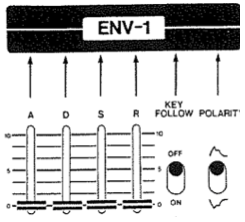
<p>“The Synth that Changed Everything”—a title bestowed upon the DX7 in a 30th anniversary retrospective in <em>Keyboard—</em>enjoyed its immense success for two reasons.<sup id="fnref:9"><a href="#fn:9" class="footnote" rel="footnote" role="doc-noteref">9</a></sup> First of all, the DX7 made use of several cutting-edge technologies, and secondly, it sold at a relatively affordable price. Perhaps the most truly groundbreaking feature of the DX7 was its envelope generator.<sup id="fnref:10"><a href="#fn:10" class="footnote" rel="footnote" role="doc-noteref">10</a></sup> The old standard for an envelope generator was a four-step envelope, or attack-decay-sustain-release (ADSR) envelope, that allowed for control of the rate of the attack (but not its level), the rate of decay, the level of the sustain, and the rate of the release (the level of which was always 0). The DX7 introduced the eight-step envelope, which allows the user to define four different levels, as well as the rates of change between each of those levels, totaling eight steps in the definition of the envelope, and opening up the possibility of all sorts of unusual envelopes. <strong>Example 1</strong> compares the envelopes of a Jupiter-8 with that of a DX7. <strong>Example 1a</strong> is a representation of the envelope interface on the Jupiter-8. Each of the four sliders corresponds to a “step” in the four-step ADSR envelope. <em>A</em> adjusts the rate of the amplitude’s increase from 0 to peak; <em>D</em> adjusts the rate of the amplitude’s decay from peak down to <em>S</em>; <em>S</em> is a user-specified amplitude; <em>R</em> is the rate of the amplitude’s decay from <em>S</em> down to 0. There are two switches: one for “key follow,” which adjusts the envelope according to the frequency of the sound to mimic an acoustic instrument, and one for “envelope inversion,” which reverses the profile of the ADSR envelope. By contrast, on the DX7, since both levels and rates of change are specified by the user, envelopes no longer needed to conform to these prototypical rules. <strong>Example 1b</strong> illustrates each of the eight steps in the eight-step envelope. While this figure uses a typically shaped envelope for its demonstration, crucially, the envelope can take on absolutely any shape, since all rates and levels are customizable.</p>

<figure class="figure">
<div class="row d-flex flex-wrap align-items-center justify-content-around">
<div class="col-md-auto flex-nowrap">
<img src="/assets/posts/dx7-2.png" class="img-fluid" />
</div>
<div class="col-md-auto flex-nowrap">
<img src="/assets/posts/dx7-3.png" class="img-fluid" />
</div>
</div>
<figcaption><strong>Example 1.</strong> A Roland Jupiter-8 envelope generator (left/top) and a Yamaha DX7 illustration of possible envelopes (right/bottom). Images taken from each synthesizer's owner's manual.
</figcaption>
</figure>

<p>This flexibility alone would provide plenty of options for most people, but the DX7 goes further: each of the six operators in the tone-generation process may be assigned its own unique amplitude envelope, once again multiplying the number of the DX7’s potential sounds, and allowing for a dynamism in the timbral profiles of these sounds that was never before possible. Some of the DX7’s presets emulated non-musical sounds, a capability made possible in part by these complex envelope options. For example, <code class="language-plaintext highlighter-rouge">TAKE OFF</code> seems to simulate an airplane or spaceship engine starting up and then launching the craft—something which does not have an amplitude profile conforming to that of a traditional or inverted four-step ADSR envelope. If desired, this same envelope generator can also be used to control the pitch, through an additional seventh envelope called the pitch EG.</p>

<blockquote>
  <p>It’s my opinion that the velocity/touch-sensitivity feature … is a major contributory factor in putting the DX7 into a class of its own.</p>

  <p class="figcaption">Jay Chapman</p>
</blockquote>

<p>The timbre of a sound on the DX7 can change further depending on how hard and/or how fast the player strikes the key: in other words, the keys are also both pressure- and velocity-sensitive. Jay Chapman, a writer for <em>Electronics &amp; Music Maker, </em>states, “It’s my opinion that the velocity/touch-sensitivity feature … is a major contributory factor in putting the DX7 into a class of its own when compared to the other polyphonic synths available in the same price range.”<sup id="fnref:11"><a href="#fn:11" class="footnote" rel="footnote" role="doc-noteref">11</a></sup> The DX7’s keyboard action was one of the best in the synthesizer market, and this technology was incorporated into the design of the sounds themselves. Another non-musical preset, <code class="language-plaintext highlighter-rouge">TRAIN</code>, would clang a train bell when the key was pressed normally, but if the player then presses harder onto the key, the sounds of a train engine chugging gradually crescendo while the bell reverberates. Sounds like <code class="language-plaintext highlighter-rouge">TRAIN</code> and <code class="language-plaintext highlighter-rouge">TAKE OFF</code> might sound quaint or gimmicky to modern ears, but this was the first time such a sound had ever been synthesized from scratch (rather than sampled).</p>

<p>Other features were not unique to the DX7, but were still on the vanguard of innovation. The DX7 was one of the earliest keyboards to make use of the now-commonplace Musical Instrument Digital Interface (better known as MIDI) technology. The DX7’s MIDI capability was limited—it only transmits on MIDI channel 1—but effective. MIDI sends data to and from the DX7, which means that users could use MIDI to exchange preset sounds, or to hook the DX7 up as a controller for other synthesizers. Coupled with the DX7’s excellent velocity and pressure sensitivity, the DX7 was a popular choice of MIDI controller. More radical was that the DX7 could be hooked up via MIDI to a breath controller, which could better simulate the sound of wind instruments. As with velocity and pressure sensitivity, Yamaha specially designed several preset sounds (those ending in “BC”) to be used with a breath controller.<sup id="fnref:12"><a href="#fn:12" class="footnote" rel="footnote" role="doc-noteref">12</a></sup> In 1983, these capabilities were very hard to find in other synthesizers.</p>

<div class="col-lg-6 mx-auto">
    <figure data-bs-toggle="lightbox" class="figure">
    <img src="/assets/posts/dx7-4.png" class="img-fluid" />
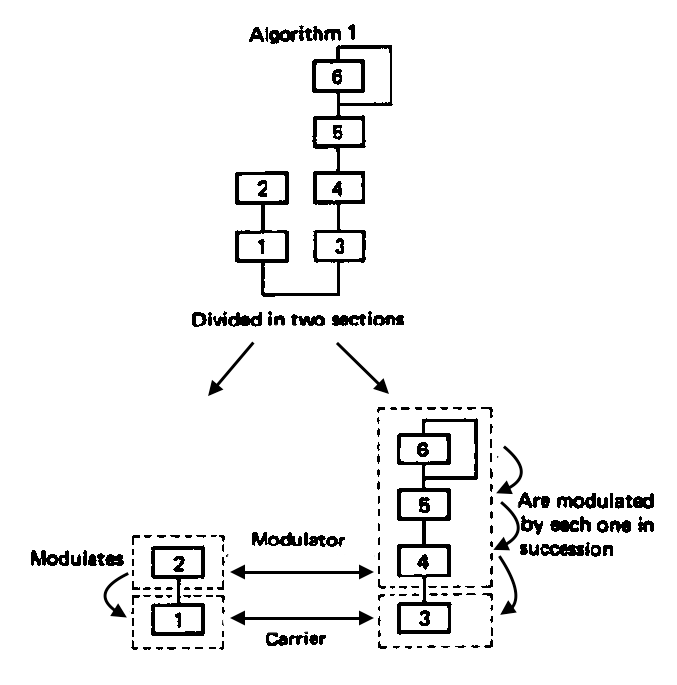
    <figcaption><strong>Example 2.</strong> An example algorithm, with the roles of each operator clearly marked.
    </figcaption>
    </figure>
</div>

<p>FM synthesis is really what lies at the heart of the DX7’s innovative status. FM is a highly versatile method of sound synthesis, capable of producing a wide range of timbres, if one knows how to program with FM. Although a complete discussion of the processes involved in FM synthesis is beyond the scope of this project, a short overview is helpful in understanding what makes the FM synthesis process of the DX7 so revolutionary compared to subtractive synthesis on analog machines.<sup id="fnref:13"><a href="#fn:13" class="footnote" rel="footnote" role="doc-noteref">13</a></sup> FM synthesis on the DX7 begins with the generation of sine waves from the DX7’s digitally controlled oscillators, called <em>operators</em>. An operator can be either a carrier wave or a modulator wave in the FM sound synthesis process (as in FM radio), and these carriers and modulators can feed into one another through various arrangements, known as <em>algorithms</em>. In an algorithm with only two operators, often one operator would be the carrier and the other the modulator (<strong>Example 2</strong>). Relating this abstract mathematical concept to musical sound, the frequency of a carrier will determine the pitch of the note played, while the frequency of a modulator will affect the timbre. The DX7 has six operators, each of which might be turned on or off, and the programmer may arrange these operators into one of thirty-two different algorithms, dictating which operators are modulators or carriers and the relationship between them all. Factoring all these variables together, the number of possible sounds is immense. This vast universe is quickly made apparent to the user of a DX7 through the visual map of all 32 algorithms painted directly onto the face of the instrument (<strong>Example 3</strong>).</p>

<figure data-bs-toggle="lightbox" class="figure">
<img src="/assets/posts/dx7-5.png" class="img-fluid" />
<figcaption><strong>Example 3.</strong> The thirty-two possible algorithms used to program DX7 sounds.
</figcaption>
</figure>

<p>The innovation of FM synthesis was the greatest strength of the DX7, but also, paradoxically, its greatest failure. The DX7 rapidly gained a reputation as being difficult to program, a reputation that endures to this day, due to the relative complexity of FM synthesis. Using an algorithm to modulate carrier sine waves with other sine waves is not as easily understood by a layperson as the subtractive synthesis technologies used by most analog machines.<sup id="fnref:14"><a href="#fn:14" class="footnote" rel="footnote" role="doc-noteref">14</a></sup> The daunting new FM digital system motivated many artists’ rejections of the DX7. Alan Howarth, for example, said,</p>

<blockquote>
  <p>I’m not a real DX7 fan … I never warmed up to it, and along came the [Sequential Circuits Prophet VS, a hybrid digital-analog synth]. It gave me some pretty neat sounds. The digital waveforms were nice and bright, and they gave me all the [Hohner] Clavinet and [Fender] Rhodes things, and I could still deal with it in an analog fashion, which is what I’m most familiar with.</p>

  <p class="figcaption">Alan Howarth, quoted in Burger (1986, 16).</p>
</blockquote>

<p>This reveals that although Howarth was interested in the sound of digital synthesis, he was reluctant to spend time stumbling on the learning curve of this entirely new system of sound creation.<sup id="fnref:15"><a href="#fn:15" class="footnote" rel="footnote" role="doc-noteref">15</a></sup> Midge Ure similarly states, “The DX7 … I still think is impossible to program! I can’t be bothered with it.”<sup id="fnref:16"><a href="#fn:16" class="footnote" rel="footnote" role="doc-noteref">16</a></sup></p>

<p>Further obfuscating the process of programming the DX7 is its unintuitive user interface. On virtually every other synthesizer before the DX7, timbres were created and adjusted by fiddling with a number of knobs. All these knobs were laid out plainly before the programmer’s eyes; one knob controlled one parameter. The programmer could press and hold a key on the synthesizer, simultaneously twist knobs back and forth, and hear the effect of these adjustments on the sound. The process of creating an analog sound was fairly intuitive, and one did not necessarily need to know about acoustics or anything else mathematical in order to create nice sounds.</p>

<p>A DX7 programmer, on the other hand, interacts with the FM synthesis algorithms through a series of membrane buttons and one slider that increases or decreases numbers. What the slider and the buttons do might change depending on what “mode” the programmer is using—which may seem simple enough, but this simple barrier puts a significant conceptual filter between the visible interface and the technology. Even the conceptually straightforward slider does not provide the programmer with real-time feedback while adjusting the numbers with the slider: before the programmer can hear what they have done, the sound has to be saved, the DX7 switched over from “edit” mode to “play” mode, and only then can the programmer press a key and hear the results. Listening to the sound is Step 10 in the step-by-step guide to creating a sound in the DX7 owner’s manual. There is no way for programmers to experience the effect of their changes to the algorithm in time as they make the changes.</p>

<blockquote>
  <p>The DX7 … I still think is impossible to program! I can’t be bothered with it.</p>

  <p class="figcaption">Midge Ure</p>
</blockquote>

<p>All of this information is only communicated to the DX7 programmer on a tiny, non-backlit LCD screen, capable of displaying only two rows of sixteen characters each. As Ted Greenwald, an editor for <em>Keyboard</em> magazine, summarizes, “Admittedly, the difficulty of DX programming stems as much from the differences between analog and FM synthesis, and between [four-step] and [eight-step] envelopes, but there was clearly a need for a front panel that related, in graphic terms, to the structure of any given patch.”<sup id="fnref:17"><a href="#fn:17" class="footnote" rel="footnote" role="doc-noteref">17</a></sup> The combination of the more abstract mathematics behind sound generation, the substantial differences between analog and digital technology, and the difficult interface led to a total avoidance of programming the DX7 by the vast majority of keyboardists.</p>

<p>Given the degree of obfuscation in the process of editing a timbre on the DX7, the instrument’s status as a best-selling synthesizer may seem completely surprising, but the DX7 had one crucial redemptive feature: the pre-programmed factory preset sounds. Thirty-two factory presets were saved into the synthesizer’s internal memory. A cartridge reader gives users access to even more sounds, read from either ROM or RAM cartridges.<sup id="fnref:18"><a href="#fn:18" class="footnote" rel="footnote" role="doc-noteref">18</a></sup> Every new DX7 shipped with two ROM cartridges from Yamaha with sixty-four sounds each, thirty-two of which were the same sounds programmed in the internal memory, yielding a total of 128 different sounds that came with the synthesizer.<sup id="fnref:19"><a href="#fn:19" class="footnote" rel="footnote" role="doc-noteref">19</a></sup></p>

<p>The DX7 was one of the earliest synthesizers to come equipped with such pre-programmed sounds, referred to as “presets.”<sup id="fnref:20"><a href="#fn:20" class="footnote" rel="footnote" role="doc-noteref">20</a></sup> In older synthesizers, before the advent of computing and digital memory, there were no such thing as presets—presets are created with digital memory, and digital computing was still new in 1983. On synthesizers like the Minimoog, instead of presets, players had to recreate sounds anew each time, by fiddling with knobs and sliders. To keep track of these sounds, people would write them down on charts. To switch sounds back and forth, one had to physically move the knobs back and forth—or one could take after Rick Wakeman, who is said to have bought thirteen Minimoogs and surrounded himself with them at his shows.<sup id="fnref:21"><a href="#fn:21" class="footnote" rel="footnote" role="doc-noteref">21</a></sup> When digital memory was available, people used it to save their own pre-programmed sounds, not to use other people’s sounds. Where factory presets were available, for example, on the Jupiter-8, they were frequently saved over with the user’s own sounds, or otherwise not much used. As Paul Théberge notes, the reason older synthesizers did not have presets was not, as one might assume, because the technology did not previously exist, but rather because instrument makers did not believe there was a demand for the feature.<sup id="fnref:22"><a href="#fn:22" class="footnote" rel="footnote" role="doc-noteref">22</a></sup> Synthesizers had only ever existed as a specialized and exclusive kind of instrument, and so in the early days of the synthesizer, people that wanted to play synthesizers were the same people that wanted to learn how to become synthesizer programmers.</p>

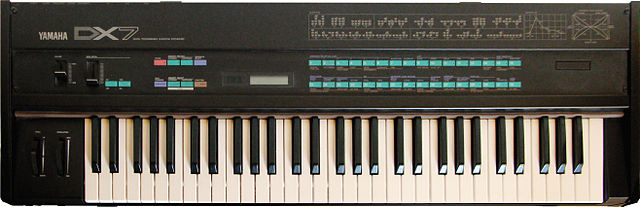
<p>Synthesizers became more integral to the sound of popular music throughout the course of the 1980s. Many everyday musicians, such as those playing in garage bands, wanted to buy their first synthesizer, but had no familiarity with the basic concepts of synthesizer programming. By 1983, the availability of presets made the DX7 exceptionally attractive to such keyboardists. Instead of needing to learn about subtractive synthesis, with its oscillators, filters, and waveforms—or worse, needing to learn about FM synthesis!—the salesperson could show buyers that they simply needed to press one of the thirty-two buttons on the face of the DX7 to quickly access any sound. Bass, harpsichord, Rhodes, brass, organ, strings, bells, and more: everything the buyer might need was available with the push of a button, no twiddling of knobs or comprehension of algorithms required. Sounds on the DX7 are literally at the player’s fingertips (Example 4).</p>

<figure data-bs-toggle="lightbox" class="figure">
<img src="/assets/posts/dx7-6.jpg" class="img-fluid" />
<figcaption><strong>Example 4.</strong> The front of a Yamaha DX7. Players access preset sounds with the two rows of sixteen buttons on the right. Image via Wikimedia Commons, © <a href="https://creativecommons.org/licenses/by-sa/3.0">CC BY-SA 3.0</a>.
</figcaption>
</figure>

<p>Rather than wrestle with the unforgiving programming interface, most casual players of the DX7, and even many experienced session musicians, relied solely on the presets in the internal memory or cartridges. In October 1986, when the DX7 had been on the scene for three years, producer David Briggs expressed a sentiment shared by many music makers of the 1980s: “I haven’t had the need [to program the DX7 myself.] Most of the factory sounds that I use are great, and I haven’t been able to improve on them. … Everybody wants the brass, electric piano, and string sounds.”<sup id="fnref:23"><a href="#fn:23" class="footnote" rel="footnote" role="doc-noteref">23</a></sup> Théberge similarly reports, “By the end of [the 1980s], marketing departments were estimating that as few as 10 percent of users programmed their own sounds.”<sup id="fnref:24"><a href="#fn:24" class="footnote" rel="footnote" role="doc-noteref">24</a></sup> The DX7 was a large part of a paradigm shift in what a synthesizer was expected to offer.</p>

<p>What clinched the DX7’s place in synthesizer history was not just its offering all these revolutionary features, but that it offered them at a significantly lower price. Other comparably priced synthesizers, such as the analog Korg PolySix, used more derivative technologies, yet the DX7 competed with the PolySix in price while offering cutting-edge technical specifications. Dave Formula, a keyboardist for the bands Magazine and Visage, raved in April 1984 shortly after the release of the DX7, “… [the DX7] gives you so much for the price. You can compare it with things that cost six times as much, and I don’t see that much difference.”<sup id="fnref:25"><a href="#fn:25" class="footnote" rel="footnote" role="doc-noteref">25</a></sup> The DX7 was priced significantly lower than other revolutionary synthesizers, which played a large factor in the popularity and subsequent influence that the DX7 exerted over the popular music scene (<strong>Example 5</strong>). Bob Moog, the inventor of the Moog synthesizer, spoke of the revolution in synthesizer pricing, which the DX7 helped to spur, as a “democratization” of the synthesizer.</p>

<blockquote class="small">
  <p>The first microprocessor-controlled synthesizers were strictly professional instruments, with price tags of $5,000 and up. … [Today], no matter how much or how little money you have in your pocket, you can almost certainly find a synthesizer that will give you some musical satisfaction.</p>

  <p>As a result the number of musicians who own these instruments has increased dramatically. Early last year I went to catch a Korg clinic which was put on by Chuck Leavell at a local music store in Asheville, North Carolina. As his final demo, Chuck played the Korg Poly 800 and blew the audience away. Here was a portable 8-voice keyboard with programmability and MIDI that cost less than a plane trip to the Coast!</p>

  <p>The fact that the event took place in North Carolina should not be overlooked. … Before then, you couldn’t really buy a synthesizer in Asheville. You had to travel three hours to Charlotte, North Carolina’s largest city. But by 1984, the salesman knew his way around keyboard synthesizers, Chuck Leavell demoed to a hundred or so musicians, and suddenly synthesizers were a musical presence in North Carolina. That’s what I mean by “democratization.”</p>

  <p class="figcaption">Bob Moog (1985, 42).</p>
</blockquote>

<p>As I discuss in <a href="https://www.mtosmt.org/issues/mto.20.26.3/mto.20.26.3.lavengood.html">Lavengood (2020)</a>, the availability of the DX7 and other synthesizers meant that more musicians had access to unusual sounds in their music—to borrow Moog’s terminology, it “democratizes” the novelty sound in popular music. As technologies become cheaper and more accessible, the trajectory of popular music’s sound is altered.</p>

<figure>
    <table class="table table-light table-hover">
    <thead>
    <tr>
    <th>Synthesizer name (year)</th>
    <th>List price (USD)</th>
    <th>Adjusted for inflation (2017)</th>
    </tr>
    </thead>
    <tbody>
    <tr>
    <td>Fairlight CMI (1979)</td>
    <td>$25,000</td>
    <td>$83,100</td>
    </tr>
    <tr>
    <td>New England Digital Synclavier II, 8-voice (1979)</td>
    <td>$13,750</td>
    <td>$45,700</td>
    </tr>
    <tr>
    <td>Yamaha GS1 ( 1981)</td>
    <td>$11,850</td>
    <td>$33,150</td>
    </tr>
    <tr>
    <td>PPG Wave 2.2 (1982)</td>
    <td>$8,800</td>
    <td>$22,000</td>
    </tr>
    <tr>
    <td>E-MU Emulator II (1984)</td>
    <td>$7,995</td>
    <td>$18,500</td>
    </tr>
    <tr>
    <td>Roland Jupiter-8 (1981)</td>
    <td>$5,295</td>
    <td>$14,000</td>
    </tr>
    <tr>
    <td>Yamaha DX7 (1983)</td>
    <td>$1,995</td>
    <td>$4,800</td>
    </tr>
    </tbody>
    </table>
    <figcaption><strong>Example 5.</strong> List prices in USD of various 1980s synthesizers.</figcaption>
</figure>

<h2 id="reception-of-the-dx7-and-other-digital-technology">Reception of the DX7 and Other Digital Technology</h2>

<p>The DX7 is part of a collection of advances in synthesizer technology that together changed the rules for what it took to be a keyboardist. Digital technology also delivered sequencers and arpeggiators to the public. These electronic tools made the synthesizer an accessible choice even for untrained keyboardists. A sequencer is a computer that can store and recall patterns entered by the programmer. The programmer does not necessarily have to enter these patterns in real time, which introduces the possibility of programming something that would be quite difficult to perform if played live. An arpeggiator function allows a keyboardist to hold down a chord while the arpeggiator transforms the chord into a random, rapid arpeggio, hence the name for the technology. This of course makes complex and energetic arpeggios far easier to play, even while performing live. Bob Doerschuk, a prolific music journalist and regular writer for <em>Keyboard</em> magazine, wrote of The Human League, “Like electronic magicians, they dazzled their audiences by producing lots of music while playing as little as possible. The point of <em>Dare</em> [1981] seemed to be that you didn’t even need to know how to play at all to be in a pop band—a point made many times since then.”<sup id="fnref:26"><a href="#fn:26" class="footnote" rel="footnote" role="doc-noteref">26</a></sup> Using these tools, one barely had to know how to play a keyboard to perform rhythmic and driving licks that would previously have been virtuosic.</p>

<p>This paradigm shift, unsurprisingly, motivated some music makers of the time to vocally oppose these technologies.<sup id="fnref:27"><a href="#fn:27" class="footnote" rel="footnote" role="doc-noteref">27</a></sup> Some saw the wild success of the DX7 as yet another example within a larger trend of moving toward simplicity and automation in keyboards and rock music. For their February 1986 issue, <em>Keyboard</em> magazine featured Duran Duran’s keyboardist, Nick Rhodes, as their cover story, a move that outraged those <em>Keyboard</em> subscribers who thought the magazine should stay focused on virtuosi (in turn focusing on the genres of classical, jazz, and progressive rock). Consider this letter to the editor, which was published in the June 1986 issue: “How I miss the good old pre-DX7 days. I am so sick of reading about these Fairlight freaks and one-finger virtuosos. As a performer, Nick Rhodes is a joke. Why don’t you interview a <em>real </em>keyboard player, like Rick Wakeman?”<sup id="fnref:28"><a href="#fn:28" class="footnote" rel="footnote" role="doc-noteref">28</a></sup> The letter writer is an example of those that view technologies that facilitate performance and composition with suspicion; i.e., people who are concerned with the relationship between synthesizers, sequencers, arpeggiators, and the notion of authenticity (revealed in the letter-writer’s declaration that Wakeman is a “real” keyboard player). This letter-writer seems unaware that Nick Rhodes actually rarely used the DX7, a fact that Rhodes plainly states in the very same interview that the letter-writer complains about.<sup id="fnref:29"><a href="#fn:29" class="footnote" rel="footnote" role="doc-noteref">29</a></sup> The letter-writer’s misattribution of the decline of keyboard-playing society to the rise of the DX7 shows that the DX7 was the poster child for these developments, even when not directly responsible for the declinational performances.</p>

<blockquote>
  <p>How I miss the good old pre-DX7 days.</p>

  <p class="figcaption">Steve Cross</p>
</blockquote>

<p>The DX7 does not make the physical aspects of performance any easier; it has no built-in arpeggiators or sequencers to take away the hard work of moving quickly and adeptly around the keyboard. What really made the DX7 a target for criticism from music-makers concerned with “authenticity” was, instead, the factory presets. The presets meant that synthesizer players were no longer required to be experts in synthesizer programming, which lowered the bar of entry for aspiring keyboardists. Perhaps inevitably, reliance on presets was equated with inauthentic and low-quality music by many musicians. Roland Orzabal of Tears for Fears spits, “Stop using the bloody DX7 presets and invent something new of your own … People should stop pissing around with synthesizers and make fucking good music.”<sup id="fnref:30"><a href="#fn:30" class="footnote" rel="footnote" role="doc-noteref">30</a></sup> Philip Oakey of The Human League, on the other hand, expressed a more complex frustration with his and his bandmates’ continuing use of the DX7 presets as he reflected on the recording process during an interview with Doerschuk.</p>

<blockquote>
  <p>They get really bland after a while. And when we get into what I call the DX Sound Hunt, it drives me up the wall. Someone in the studio will say, ‘Okay! Let’s have a bell sound.’ Then we start going through the 128 sounds on our DX—we have the Sycologic MX1 expander board—and playing every one, including the whistle, the train, and the bombs. If we find something we like, it has probably turned up on 50 records that have been made over the past few years. But chances are we’ll give up after half an hour and say, “I guess we’d better [rent] a PPG.” Why couldn’t we get our own sound, like we did in the Dare days?</p>

  <p class="figcaption">Philip Oakey, quoted in Doerschuk (1987a, 88–89).</p>
</blockquote>

<p>In this interview, Oakey seems to be regretful, or even in denial, of using the DX7 presets, yet DX7 presets saturate The Human League’s album <em>Crash,</em> released in September of 1986 and produced by Jimmy Jam and Terry Lewis, only eight months prior to this comment.<sup id="fnref:31"><a href="#fn:31" class="footnote" rel="footnote" role="doc-noteref">31</a></sup> Similarly, singer-songwriter Joe Walsh (formerly a member of the Eagles) publicly expresses a bit of embarrassment about using the presets during an interview with <em>Keyboard</em> magazine—”I very seldom go through presets. I don’t like anybody to see me sliding my finger up and down the presets on the DX7”—yet DX7 presets can be heard on tracks in his 1985 album <em>The Confessor</em>, released a little over a year before that commen.<sup id="fnref:32"><a href="#fn:32" class="footnote" rel="footnote" role="doc-noteref">32</a></sup> Walsh also uses some DX7 presets, albeit to a lesser extent, on <em>Got Any Gum?</em> (1987), released just over one year after the interview in <em>Keyboard</em>.<sup id="fnref:33"><a href="#fn:33" class="footnote" rel="footnote" role="doc-noteref">33</a></sup> The common attitude toward DX7 presets in the mid-1980s can perhaps be understood like that toward Auto-Tune today: everyone uses it, but no one wants to admit it.</p>

<p>The prevalence of the presets led musicians to believe that the DX7 was an inflexible instrument—the DX7 was sometimes thought of like a cheap Casio meant for performance only, rather than a robust FM digital synthesizer. For example, Joe Zawinul, keyboardist of the fusion band Weather Report, said, “… I don’t think [digital synthesizers are] as flexible as I want them to be. I played the DX7 for a couple of nights in Japan and I really like it. … I think Yamaha has some really good things, but I can’t deal with all the sounds they’ve got—after a while, they get stale.”<sup id="fnref:34"><a href="#fn:34" class="footnote" rel="footnote" role="doc-noteref">34</a></sup> Here, Zawinul seems to think that the “sounds they’ve got,” i.e., the presets, are an essential part of the instrument, rather than something that can be either used or discarded. This evaluation of the DX7 as an inflexible instrument is factually incorrect, since, as described earlier, the number of possible sounds is virtually infinite, when factoring in the variables such as the thirty-two different algorithms and the possibility for different eight-step envelopes for each of the six operators.</p>

<p>But very few practicing musicians were able to successfully program the DX7 and make their own customized sounds. The most famous person to do so is probably Brian Eno. Eno was largely protective of the patches he programmed, like many programmers, since at this time patches were not copyrightable.<sup id="fnref:35"><a href="#fn:35" class="footnote" rel="footnote" role="doc-noteref">35</a></sup> Eno nevertheless would give small hints about his methods for making the DX7 sound more unique, as in this 1988 interview:</p>

<blockquote>
  <p>I’ve found ways to de-stabilize the DX7 a little bit to create interactions between it and other instruments that are more interesting … I don’t have very good voltage supply, for instance. Within the patches, I build in certain elements that don’t repeat. For instance, there’s something wrong with the programming of envelope generator four on the original DX7 and you can use that to create non-repeating patches. If you have that set to a value under 50, you’ll find that the synthesizer behaves unpredictably. Unfortunately they’ve sorted this out on the second generation of DX7s, so I still use the first one, and that’s an important element of quite a few of my patches.</p>

  <p class="figcaption">Brian Eno, quoted in Diliberto (1988, 54).</p>
</blockquote>

<p>Eno’s ambition and dedication to learning to program the DX7 was not the norm, however. The vast majority of DX7 players indeed seem to have relied on the presets, the Yamaha ROM cartridges, or even additional presets purchased from the cottage industry of DX7 presets for sale that germinated during this time.</p>

<p>A relatively small handful of presets became particularly widespread throughout the pop music of the 1980s. I have not done a rigorous statistical analysis of the prevalence of all the presets, but to me, E. PIANO 1—the DX7 version of the Fender Rhodes electric piano—seems to be the most ubiquitous.<sup id="fnref:36"><a href="#fn:36" class="footnote" rel="footnote" role="doc-noteref">36</a></sup> BASS 1 is perhaps the next most common, and certainly at least as iconic as E. PIANO 1. BASS 1 mimics a funky slap bass, and frequently opens a track with an aggressive riff, as in “Danger Zone” by Kenny Loggins (1986). Other common groups of sounds include the DX7 “flute sounds,” such as <code class="language-plaintext highlighter-rouge">FLUTE 1</code>, <code class="language-plaintext highlighter-rouge">CALIOPE</code>, and <code class="language-plaintext highlighter-rouge">VOICE 1</code>; percussive sounds, like <code class="language-plaintext highlighter-rouge">MARIMBA</code>, <code class="language-plaintext highlighter-rouge">COWBELL</code>, and <code class="language-plaintext highlighter-rouge">LOG DRUM</code>; bell sounds, like <code class="language-plaintext highlighter-rouge">TUB BELLS</code> (tubular bells) and <code class="language-plaintext highlighter-rouge">CELESTA</code>; and plucked sounds, like <code class="language-plaintext highlighter-rouge">CLAV 1</code> and <code class="language-plaintext highlighter-rouge">HARPSICH 1</code>.<sup id="fnref:37"><a href="#fn:37" class="footnote" rel="footnote" role="doc-noteref">37</a></sup></p>

<h2 id="after-the-dx7">After the DX7</h2>

<p>As more and more DX7 players repeatedly returned to these presets on hundreds of records throughout the 1980s, the sound of the presets eventually became recognizable. This quickly diminished the appeal of the instrument, and I hypothesize that perhaps the DX7 sounds particularly dated today because of the existence of the factory presets; perhaps an analog instrument that was more easily customizable wouldn’t have had such an easily recognizable sound. The DX7 became less and less popular as a synthesizer toward the end of the 1980s and into the 1990s, until finally the DX7 had a truly bad reputation and was essentially synonymous with cheesiness.<sup id="fnref:38"><a href="#fn:38" class="footnote" rel="footnote" role="doc-noteref">38</a></sup> The Roland D-50 synthesizer, released in 1987, which blended sampled attack sounds with digitally synthesized sustain portions of tone, was the first blow to the DX7’s previously uncontested dominance. The Korg M1, an inexpensive sample-based synthesizer released in 1988, completely dethroned the DX7, even breaking the record for most units sold by any synthesizer, which had previously belonged to the DX7.</p>

<figure data-bs-toggle="lightbox" class="figure">
<img src="/assets/posts/dx7-7.png" class="img-fluid" />
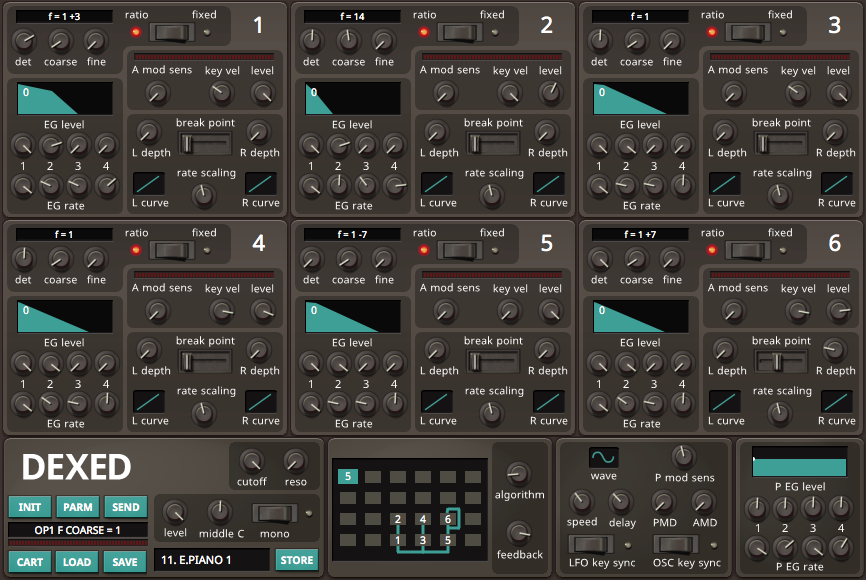
<figcaption><strong>Example 6.</strong> A screenshot of Dexed, a DX7 librarian and patch editor plugin for digital audio workstations.
</figcaption>
</figure>

<p>Now that digital audio workstations (DAWs), digital instruments, and virtual studio technology (VST) have made the sounds of vintage synthesizers more accessible to a larger section of the population, digital FM sounds have returned to the music scene. Modern technology also facilitates the cumbersome process of editing an FM sound, so contemporary music producers are more interested in learning about the process of FM synthesis than music makers of the ’80s or ’90s (<strong>Example 6</strong>). Even DX7 preset sounds have had a resurgence in popularity: for example, Bruno Mars’s 2016 album <em>24K Magic</em>, which reached #2 in the U.S. and #3 in the U.K., uses several DX7 presets or sounds that are mimicking DX7 presets. Ultimately, whether or not <em>24K Magic </em>uses actual DX7 presets or FM synthesis sounds that merely resemble DX7 presets is beside the point: the DX7 sound has made a comeback in recent years, after a slump in popularity in the ’90s and early 2000s.</p>

<p>While the average music consumer, or even most music enthusiasts or music theorists, may not be aware of the Yamaha DX7 as a musical phenomenon, every person who listens to 1980s Anglo/American popular music is familiar with the sound of the DX7 synthesizer. As I have shown through this constellation of remarks from music makers of the 1980s, musicians were constantly using and discussing the DX7 in their music.</p>

<h2 id="bibliography">Bibliography</h2>

<p><a href="https://meganlavengood.com/research/dissertation/bibliography" class="btn btn-primary">View bibliography</a></p>

<p><em>This post is adapted from chapter 2 of my dissertation, which is the only part of the dissertation that I never reworked for a peer-reviewed article.</em></p>

<h2 id="more-links">More links</h2>

<p><a href="https://meganlavengood.com/research/dx7-links/" class="btn btn-primary">DX7 links</a></p>

<h2 id="footnotes">Footnotes</h2>

<div class="footnotes" role="doc-endnotes">
  <ol>
    <li id="fn:1">
      <p>Cateforis (2011) details this evolution in Chapter 6, “Roll Over Guitar Heros, Synthesizers Are Here…”. <a href="#fnref:1" class="reversefootnote" role="doc-backlink">&#8617;</a></p>
    </li>
    <li id="fn:2">
      <p>For a detailed history of the Moog and the Minimoog, see Pinch and Trocco (2004). <a href="#fnref:2" class="reversefootnote" role="doc-backlink">&#8617;</a></p>
    </li>
    <li id="fn:3">
      <p>By the late 1980s, sampling-based synthesizers had finally become more affordable, at which point they did become quite popular. Later in this essay I discuss the Korg M1, the most popular sampling-based keyboard. <a href="#fnref:3" class="reversefootnote" role="doc-backlink">&#8617;</a></p>
    </li>
    <li id="fn:4">
      <p>After 1986, Yamaha produced successors to the DX7, the DX7II and the DX7II FD. There were no further DX7II FDs produced after 1989, which likely solidifies the role of the DX7 as a quintessentially ’80s synthesizer (Vail 2002, 130). <a href="#fnref:4" class="reversefootnote" role="doc-backlink">&#8617;</a></p>
    </li>
    <li id="fn:5">
      <p>Quoted in Frederick (1986, 46). As the interview title insinuates, Rushen played piano from a very young age. She was classically trained before she released her jazz albums, which used the DX7 and other synthesizers. <a href="#fnref:5" class="reversefootnote" role="doc-backlink">&#8617;</a></p>
    </li>
    <li id="fn:6">
      <p>Quoted in Doerschuk (1986c, 72). <a href="#fnref:6" class="reversefootnote" role="doc-backlink">&#8617;</a></p>
    </li>
    <li id="fn:7">
      <p>Quoted in Doerschuk (1987b, 85). <a href="#fnref:7" class="reversefootnote" role="doc-backlink">&#8617;</a></p>
    </li>
    <li id="fn:8">
      <p>Quoted in Darter (1985, 24). <a href="#fnref:8" class="reversefootnote" role="doc-backlink">&#8617;</a></p>
    </li>
    <li id="fn:9">
      <p><em>Keyboard</em> (2003, 40). <a href="#fnref:9" class="reversefootnote" role="doc-backlink">&#8617;</a></p>
    </li>
    <li id="fn:10">
      <p>“Envelope” is a common term in synthesizer programming, referring to the amplitude profile of a sound. Typically, a sound begins at zero, peaks shortly thereafter during the attack (A), decays slightly (D) and then maintains a somewhat lower volume as the pitch sustains (S), and then releases (R) back down to zero. <a href="#fnref:10" class="reversefootnote" role="doc-backlink">&#8617;</a></p>
    </li>
    <li id="fn:11">
      <p>Chapman (1984, 70). <a href="#fnref:11" class="reversefootnote" role="doc-backlink">&#8617;</a></p>
    </li>
    <li id="fn:12">
      <p>A list of the DX7’s preset sounds can be found on <a href="https://www.synthmania.com/dx7.htm">Synthmania.com</a>. <a href="#fnref:12" class="reversefootnote" role="doc-backlink">&#8617;</a></p>
    </li>
    <li id="fn:13">
      <p>The inventor of FM synthesis has published very complete and succinct explanations of synthesis via frequency modulation from a mathematical perspective, including concepts such as the modulation index, and how one might simulate various kinds of acoustic instruments (Chowning 1973). <a href="#fnref:13" class="reversefootnote" role="doc-backlink">&#8617;</a></p>
    </li>
    <li id="fn:14">
      <p>Additive and subtractive synthesis both start from the understanding of timbre as made up of the fundamental and the partials above it. Different sounds are created by adjusting the number of partials and their volume. <a href="#fnref:14" class="reversefootnote" role="doc-backlink">&#8617;</a></p>
    </li>
    <li id="fn:15">
      <p>This quote from Howarth also exemplifies the idea that people wanted the DX7 as a replacement for the Hohner Clavinet and the Fender Rhodes, which I discuss more in <a href="https://jpms.ucpress.edu/content/31/3/73">Lavengood (2019)</a>. <a href="#fnref:15" class="reversefootnote" role="doc-backlink">&#8617;</a></p>
    </li>
    <li id="fn:16">
      <p>Quoted in Gilby (1985, 39). Note however that despite this, Ure does use the DX7 in many of his own tracks, such as “Do They Know It’s Christmas?” by Band Aid, which I analyze in <a href="https://www.mtosmt.org/issues/mto.20.26.3/mto.20.26.3.lavengood.html">Lavengood (2020)</a>. <a href="#fnref:16" class="reversefootnote" role="doc-backlink">&#8617;</a></p>
    </li>
    <li id="fn:17">
      <p>Greenwald (1986). <a href="#fnref:17" class="reversefootnote" role="doc-backlink">&#8617;</a></p>
    </li>
    <li id="fn:18">
      <p>RAM (random-access memory) cartridges could be rewritten, so users could store their own custom sounds on RAM cartridges. ROM (read-only memory) cartridges were not able to be edited. <a href="#fnref:18" class="reversefootnote" role="doc-backlink">&#8617;</a></p>
    </li>
    <li id="fn:19">
      <p>Japan and Europe received Yamaha’s ROMs #1 and #2, while the United States received ROMs #3 and #4. The presets on ROM #1a and #3a were saved in the internal memory of Japanese/European and American synthesizers, respectively. Most of the presets were shared between 1/2 and 3/4, but some sounds appear only on one region’s ROMs. A list of the DX7’s preset sounds can be found on <a href="https://www.synthmania.com/dx7.htm">Synthmania.com</a>. <a href="#fnref:19" class="reversefootnote" role="doc-backlink">&#8617;</a></p>
    </li>
    <li id="fn:20">
      <p>One precedent for this technology can be found in home organs, such as the Lowrey Berkshire Deluxe, which would have some preset sounds that were not user-programmable. <a href="#fnref:20" class="reversefootnote" role="doc-backlink">&#8617;</a></p>
    </li>
    <li id="fn:21">
      <p>Pinch (2005, 259). I enjoy this story, but some find it doubtful that Wakeman really had thirteen Minimoogs. I was only able to find photo evidence of him simultaneously using four. <a href="#fnref:21" class="reversefootnote" role="doc-backlink">&#8617;</a></p>
    </li>
    <li id="fn:22">
      <p>Théberge (1997, 75–8). <a href="#fnref:22" class="reversefootnote" role="doc-backlink">&#8617;</a></p>
    </li>
    <li id="fn:23">
      <p>Quoted in Armbruster (1986, 46). Briggs was primarily based in Nashville, Tennessee, and worked mostly with country music artists. <a href="#fnref:23" class="reversefootnote" role="doc-backlink">&#8617;</a></p>
    </li>
    <li id="fn:24">
      <p>Théberge (1997, 75). This number is calculated based on the number of Sequential Circuits Prophet-5 synthesizers received at the factory for repair that still had the factory presets saved to he internal memory. However, Théberge notes also that there may be another explanation for the prevalence of factory presets on the Prophet-5s: programmers may have purged their own custom sounds before sending the synthesizers back to the factory to avoid any infringement by the company on the programmer’s intellectual property. Sounds were not copyrightable at this time, so a company could conceivably steal a programmer’s sound and sell it themselves. Théberge notes that a personal informant attested to this. <a href="#fnref:24" class="reversefootnote" role="doc-backlink">&#8617;</a></p>
    </li>
    <li id="fn:25">
      <p>Quoted in diPerna (1984, 40). <a href="#fnref:25" class="reversefootnote" role="doc-backlink">&#8617;</a></p>
    </li>
    <li id="fn:26">
      <p>Doerschuk (1987a, 86). <em>Dare</em> is the third studio album by The Human League. <a href="#fnref:26" class="reversefootnote" role="doc-backlink">&#8617;</a></p>
    </li>
    <li id="fn:27">
      <p>This is one of the senses in which new wave music, and eventually mainstream 1980s pop in general, grew out of the D.I.Y. (“do it yourself,” self-sufficient) ethic of the punk scene in the late 1970s. <a href="#fnref:27" class="reversefootnote" role="doc-backlink">&#8617;</a></p>
    </li>
    <li id="fn:28">
      <p>Steve Cross, letter to the editor, <em>Keyboard</em> (June 1986): 6. <a href="#fnref:28" class="reversefootnote" role="doc-backlink">&#8617;</a></p>
    </li>
    <li id="fn:29">
      <p>Doerschuk (1986b, 76). <a href="#fnref:29" class="reversefootnote" role="doc-backlink">&#8617;</a></p>
    </li>
    <li id="fn:30">
      <p>Quoted in Rue and Goodyer (1990, 53). <a href="#fnref:30" class="reversefootnote" role="doc-backlink">&#8617;</a></p>
    </li>
    <li id="fn:31">
      <p>Jimmy Jam and Terry Lewis’s aforementioned preference for the DX7 no doubt has something to do with the reliance on DX7 sounds on <em>Crash.</em> I hear <code class="language-plaintext highlighter-rouge">BASS 1</code> and <code class="language-plaintext highlighter-rouge">BRASS 1</code> on “Money”; <code class="language-plaintext highlighter-rouge">BRASS 3</code> on “Jam”; <code class="language-plaintext highlighter-rouge">VOICE 1</code>, <code class="language-plaintext highlighter-rouge">BASS 1</code>, and <code class="language-plaintext highlighter-rouge">KOTO</code> on “Are You Ever Coming Back”; <code class="language-plaintext highlighter-rouge">BRASS 1</code> and <code class="language-plaintext highlighter-rouge">BASS 1</code> on “I Need Your Loving”; <code class="language-plaintext highlighter-rouge">BASS 1</code> and SY<code class="language-plaintext highlighter-rouge">NBRASS 1</code> on “Party”; <code class="language-plaintext highlighter-rouge">E. PIANO 1</code> and <code class="language-plaintext highlighter-rouge">SYNBRASS 1</code> on “Love on the Run”; <code class="language-plaintext highlighter-rouge">BASS 1</code> on “The Real Thing”; and <code class="language-plaintext highlighter-rouge">LOG DRUM</code> on “Love Is All that Matters.” I think “Human” is likely using DX7 bell and plucked sounds, but I can’t identify which. <a href="#fnref:31" class="reversefootnote" role="doc-backlink">&#8617;</a></p>
    </li>
    <li id="fn:32">
      <p>Quoted in “Uses and Abuses of Synthesizers” (1986, 69). <a href="#fnref:32" class="reversefootnote" role="doc-backlink">&#8617;</a></p>
    </li>
    <li id="fn:33">
      <p>To my ears, <code class="language-plaintext highlighter-rouge">BASS 1</code> is used on “I Broke My Leg,” <code class="language-plaintext highlighter-rouge">FLUTE 2</code> on “Bubbles,” and <code class="language-plaintext highlighter-rouge">CALIOPE</code> (sic) on “Slow Dancing,” all tracks from <em>The Confessor.</em> <code class="language-plaintext highlighter-rouge">GUITAR 4</code> I think is also used in “The Radio Song,” <code class="language-plaintext highlighter-rouge">CLAV 1</code> in “Up to Me,” and <code class="language-plaintext highlighter-rouge">XYLOPHONE</code> in “Time” on <em>Got Any Gum?.</em> Walsh might also be using <code class="language-plaintext highlighter-rouge">CALIOPE</code> in “Memory Lane,” but produced somehow to sound less sharp—this sounds a bit Mellotron-ish to me, actually. <a href="#fnref:33" class="reversefootnote" role="doc-backlink">&#8617;</a></p>
    </li>
    <li id="fn:34">
      <p>Quoted in Armbruster (1984, 55). Zawinul was discussing his preference for the Sequential Circuits Prophet-5 over all types of digital keyboards, both samplers and FM synthesizers <a href="#fnref:34" class="reversefootnote" role="doc-backlink">&#8617;</a></p>
    </li>
    <li id="fn:35">
      <p>Théberge (1997, 76). <a href="#fnref:35" class="reversefootnote" role="doc-backlink">&#8617;</a></p>
    </li>
    <li id="fn:36">
      <p>E. PIANO 1 is so remarkable a phenomenon that I wrote <a href="https://jpms.ucpress.edu/content/31/3/73">an article dedicated to it</a>. <a href="#fnref:36" class="reversefootnote" role="doc-backlink">&#8617;</a></p>
    </li>
    <li id="fn:37">
      <p>“<code class="language-plaintext highlighter-rouge">CALIOPE</code>” is spelled as shown in the Yamaha ROM cartridge, rather than correctly (“calliope”). Colloquially, <code class="language-plaintext highlighter-rouge">CALIOPE</code> is frequently called a “pan flute” sound, but this should not be confused for the actual preset <code class="language-plaintext highlighter-rouge">PAN FLUTE</code>, a sound that was only available on the American ROM #4A. A list of the DX7’s preset sounds can be found on <a href="https://www.synthmania.com/dx7.htm">Synthmania.com</a>. <a href="#fnref:37" class="reversefootnote" role="doc-backlink">&#8617;</a></p>
    </li>
    <li id="fn:38">
      <p>For example, see <a href="https://www.quora.com/What-sonic-qualities-make-a-synth-a-cheesy-80s-synth">Brian McCalla, “What sonic qualities make a synth a cheesy ’80s synth?”</a>, <em>Quora</em>, last modified January 8, 2017. <a href="#fnref:38" class="reversefootnote" role="doc-backlink">&#8617;</a></p>
    </li>
  </ol>
</div>]]></content><author><name>Dr. Megan L. Lavengood</name></author><summary type="html"><![CDATA[My focus on the Yamaha DX7 synthesizer may seem overly niche or specialized, but in this essay I establish the magnitude of this synthesizer’s impact on popular music in the 1980s. While the average person is unaware of the synthesizer by name, the DX7 changed popular music as we know it today. To say that the DX7’s arrival was earth-shaking would be no exaggeration: the affordable price, sound palette, and physical feel of the instrument combined to make the DX7 the new must-have instrument in every studio, garage, and university music department in the U.S. and the U.K. My study of contemporaneous music periodicals has led me to construct a narrative that describes how the DX7 impacted the lives of working musicians in the U.S. and the U.K. in the 1980s.]]></summary></entry><entry><title type="html">What Actually Are All These Songs on the Baby Einstein Take Along Tunes Toy?</title><link href="https://meganlavengood.com/2021/07/21/what-actually-are-all-these-songs-on-the-baby-einstein-take-along-tunes-toy/" rel="alternate" type="text/html" title="What Actually Are All These Songs on the Baby Einstein Take Along Tunes Toy?" /><published>2021-07-21T16:26:37+00:00</published><updated>2021-07-21T16:26:37+00:00</updated><id>https://meganlavengood.com/2021/07/21/what-actually-are-all-these-songs-on-the-baby-einstein-take-along-tunes-toy</id><content type="html" xml:base="https://meganlavengood.com/2021/07/21/what-actually-are-all-these-songs-on-the-baby-einstein-take-along-tunes-toy/"><![CDATA[<p>For the uninitiated, the Take Along Tunes toy plays a series of excerpts from Classical- and Baroque-era (mostly) orchestral works while flashing colored lights; its purpose is to distract and occupy your baby while you’re forcing them to do something they don’t particularly enjoy (in our case, diaper changes). As musical toys go, it’s really not annoying, because the tunes are pleasant and the excerpts are long enough not to drive you up the wall with repetitiveness.</p>

<p><img src="https://www.youtube.com/watch?v=-f8JHvyOiJo" alt="video demo of the Take Along Tunes toy" /></p>

<p>While there are some obvious, Greatest-Hits-of-the-Classical-Era-type selections (<em>William Tell, Eine Kleine Nachtmusik</em>), some other excerpts stumped me.</p>

<h2 id="step-1-google">Step 1: Google.</h2>

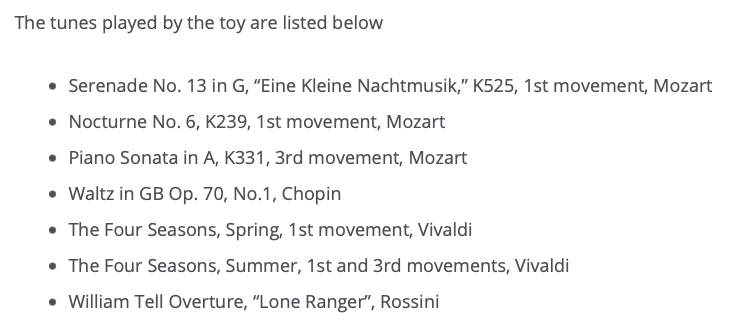
<p>I tried simply searching the internet for av list of songs, and I was able to find <a href="https://web.archive.org/web/20240413153928/https://thekidstoyscenter.com/baby-einstein-take-along-tunes/">a review of the toy</a> that appeared to have answered this question for me:</p>

<figure data-bs-toggle="lightbox" class="figure">
<img src="/assets/posts/baby-einstein-incorrect-tunes.png" class="img-fluid" alt="The tunes played by the toy are listed below. Serenade No. 13 in G, Eine Kleine Nachtmusik, K525, 1st movement, Mozart. Nocturne No. 6, K239, 1st movement, Mozart. Piano Sonata in A, K331, 3rd movement, Mozart. Waltz in GB Op. 70, No.1, Chopin. The Four Seasons, Spring, 1st movement, Vivaldi. The Four Seasons, Summer, 1st and 3rd movements, Vivaldi. William Tell Overture, Lone Ranger, Rossini." />
<figcaption>Supposedly a list of tunes for the toy.</figcaption>
</figure>

<p>A number of these were correct—all the Mozart selections, the Chopin, the Rossini, and Vivaldi “Spring”—but I listened to all of “Summer” and didn’t hear anything from the toy, and about four tunes were left unidentified.</p>

<p>Have a listen to these mystery tunes and feel yourself being transported to your last drop-the-needle test.</p>

<figure class="figure">
<audio id="baby-einstein-a" class="media" src="/assets/posts/baby-einstein-a.mp3" style="max-width: 600px;outline: none" controls="">Your browser doesn't support HTML5 audio. Here is a <a href="/assets/posts/baby-einstein-a.mp3">link to download the audio</a> instead.</audio>
<figcaption><strong>Mystery tune A.</strong> Described by one friend as having mode mixture that seems like "a Brahms or Dvořák thing, or like Berlioz"; by another as reminiscent of a trombone excerpt from <i>Damnation of Faust</i>.</figcaption>
</figure>

<figure class="figure">
<audio id="baby-einstein-b" class="media" src="/assets/posts/baby-einstein-b.mp3" style="max-width: 600px;outline: none" controls="">Your browser doesn't support HTML5 audio. Here is a <a href="/assets/posts/baby-einstein-b.mp3">link to download the audio</a> instead.</audio>
<figcaption><strong>Mystery tune B.</strong> Very short and repetitive so hard to pin down the era. Nice <a href="https://en.wikipedia.org/wiki/Galant_Schemata#Romanesca">Romanesca</a> though.
</figcaption>
</figure>

<figure class="figure">
<audio id="baby-einstein-c" class="media" src="/assets/posts/baby-einstein-c.mp3" style="max-width: 600px;outline: none" controls="">Your browser doesn't support HTML5 audio. Here is a <a href="/assets/posts/baby-einstein-c.mp3">link to download the audio</a> instead.</audio>
<figcaption><strong>Mystery tune C.</strong> That bass line plus that nonstop melody is giving major baroque vibes.That bass line plus that nonstop melody is giving major baroque vibes.
</figcaption>
</figure>

<figure class="figure">
<audio id="baby-einstein-D" class="media" src="/assets/posts/baby-einstein-D.mp3" style="max-width: 600px;outline: none" controls="">Your browser doesn't support HTML5 audio. Here is a <a href="/assets/posts/baby-einstein-d.mp3">link to download the audio</a> instead.</audio>
<figcaption><strong>Mystery tune D.</strong> Described by a friend as "bad Handel." Another person said the cadences on beat 3 in 3/4 time "suggests an early date, early in the 18th century."
</figcaption>
</figure>

<p>I then tried entering the unidentified melodies into things like Shazam and <a href="http://www.themefinder.org/">ThemeFinder.org</a>, to no avail.</p>

<p>Thus began my wild goose chase.</p>

<h2 id="step-2-musicology-twitter">Step 2: Musicology Twitter.</h2>

<p>Clearly I needed to tap a bigger network, so it was time to bring in Twitter.</p>

<p>I was encouraged when, after less than 20 minutes, a hero identified two of the four tunes as some real deep cuts.</p>

<figure data-bs-toggle="lightbox" class="figure">
<img src="/assets/posts/baby-einstein-twitter1.png" class="img-fluid" alt="Tweet from @meganlavengood: Ok classical music nerds, I need you to ID the pieces/mvts on this toy because I don't know them all and it's driving me nuts. I googled it but the answers seem wrong. Tweet from @MarkJanello: # 4 is one of the 14 'Goldberg' canons, of all things, and #5 is Vivaldi op. 3 no. 12, also arranged by Bach for keyboard." />
<figcaption>Mark Janello, music theory prof at Peabody and Music Twitter hero, identifying mystery tunes b and c (= #4 and #5 in the tweet). 
</figcaption>
</figure>

<p><em>(at the risk of exposing an embarrassing lack of knowledge about a composer I once considered writing my dissertation on</em>…)</p>

<p><strong>wtf is a Goldberg canon!?</strong></p>

<p>Apparently they were only discovered in 1975. Weird choice for a baby toy, right? <a href="https://ks4.imslp.net/files/imglnks/usimg/c/ca/IMSLP188666-WIMA.dedd-BachGoldCan.pdf">Here’s an edition of the Goldberg canons on IMSLP</a>—the toy plays #5 with some small alterations.</p>

<p>Vivaldi wrote so much stuff that I’m not surprised I couldn’t identify <a href="https://ks.imslp.net/files/imglnks/usimg/1/1d/IMSLP572180-PMLP126417-L_Estro_Armonico_--_conc_12.pdf">this violin concerto</a>. We are very far out of my wheelhouse with this one.</p>

<p>But no one was able to tackle Mystery Tunes A and D yet.</p>

<h2 id="step-3-ask-nerdy-friends">Step 3: Ask nerdy friends.</h2>

<p>As a result of being a music professor and obtaining a PhD in music geekery, I know a lot of people who seem to know everything about Classical music. I contacted some of my most savvy friends from CUNY—no IDs, although one friend suggested that D was “bad Handel” and that A had mode mixture that was “a Brahms or Dvořák thing, or like Berlioz.”</p>

<p>Then I even asked my former professor <a href="https://www.gc.cuny.edu/Faculty/Core-Bios/William-Rothstein">Bill Rothstein</a>, who I suspect has a photographic memory and seems to be able to sit down at the piano and immediately play any piece you mention from memory—<em>still nothing!</em></p>

<p>At this point I started to fear that I’d never know the answer to this mystery.</p>

<h2 id="step-4-back-to-twitter">Step 4: Back to Twitter.</h2>

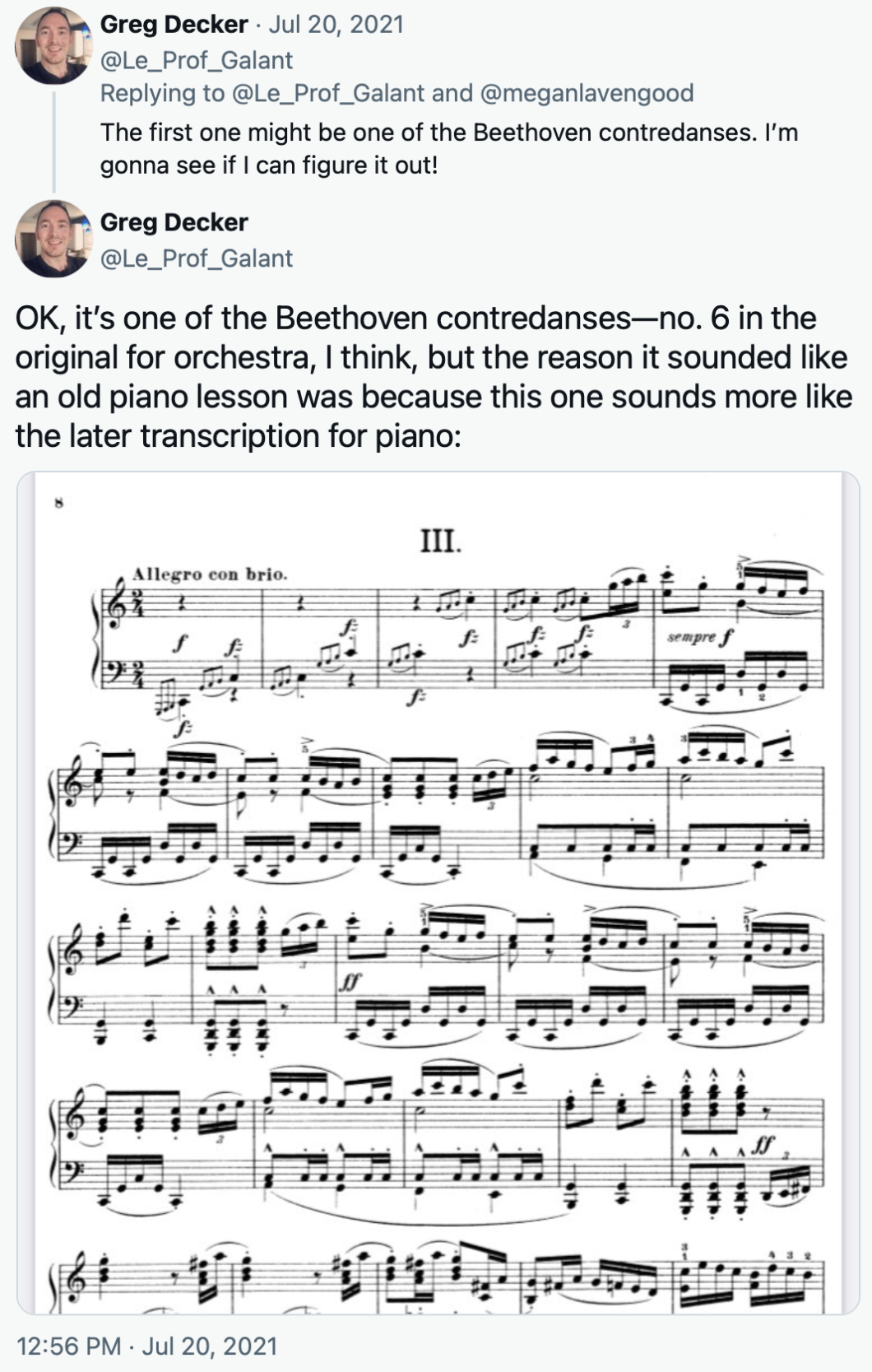
<p>I went back to Twitter to beg and plead for my followers’ help. I even tried appealing to people’s egos by mentioning they’d be out-guessing Bill Rothstein if they knew any of the answers. Yet no one answered my calls. Inspired by the suggestion that Mystery Tune D was “bad Handel,” I decided to tag in Handel scholar Greg Decker. In a surprise twist ending, though, it was Mystery Tune A that Greg was able to identify!</p>

<figure data-bs-toggle="lightbox" class="figure">
<img src="/assets/posts/baby-einstein-twitter2.png" class="img-fluid" alt="Tweet from @Le_Prof_Galant: OK, it's one of the Beethoven contredanses—no. 6 in the original for orchestra, I think, but the reason it sounded like an old piano lesson was because this one sounds more like the later transcription for piano." />
<figcaption>Greg Decker, music theory professor at Bowling Green and Beethoven "Contredanse" identifier.
</figcaption>
</figure>

<p>Music Theory Twitter begged Greg to work his magic on Mystery Tune D as well. He did admit it “could be Handel” but said he was too busy for the time being to go on a scavenger hunt. (I mean, come on, though, what could be more important?)</p>

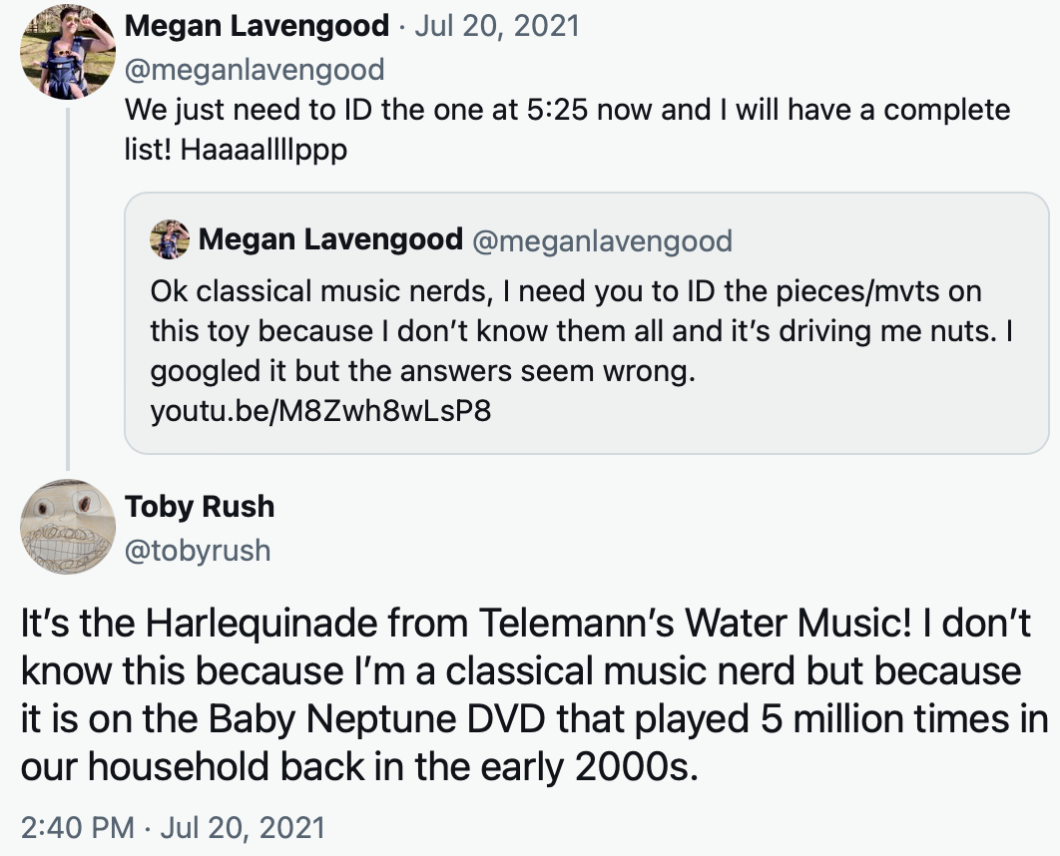
<p>But another surprise came when the final piece was identified by a theory professor whose expertise came not from their extensive schooling, but instead from their extensive family.</p>

<figure data-bs-toggle="lightbox" class="figure">
<img src="/assets/posts/baby-einstein-twitter3.png" class="img-fluid" alt="We just need to ID the one at 5:25 now and I will have a complete list! Haaaallllppp. Tweet from @tobyush: It's the Harlequinade from Telemann's Water Music! I don't know this because I'm a classical music nerd but because it is on the Baby Neptune DVD that played 5 million times in our household back in the early 2000s." />
<figcaption>Toby Rush, music theory professor at Dayton and super dad.
</figcaption>
</figure>

<p>So it turns out “bad Handel” and “early 18th-c.” were both pretty good inferences.</p>

<h2 id="the-complete-list-of-songs-in-the-take-along-tunes-toy">The Complete List of Songs in the Take Along Tunes toy</h2>

<p>Here is the actual list of pieces featured in the Baby Einstein Take Along Tunes toy and a Spotify playlist I’ve assembled for your (and my) listening pleasure.</p>

<table class="table">
<thead>
<tr>
<th>Composer</th>
<th>Piece and IMSLP link</th>
</tr>
</thead>
<tbody>
<tr>
<td>Ludwig van Beethoven</td>
<td>[12 Contradanses, WoO 14, No. 6](https://imslp.org/wiki/12_Contredanses%2C_WoO_14_(Beethoven%2C_Ludwig_van))*</td>
</tr>
<tr>
<td>Wolfgang Mozart</td>
<td>[Serenade in D major, K. 239, mvt. I](https://imslp.org/wiki/Serenade_in_D_major%2C_K.239_(Mozart%2C_Wolfgang_Amadeus))</td>
</tr>
<tr>
<td>Frédéric Chopin</td>
<td>[Waltz, Op. 70, No. 1](https://imslp.org/wiki/Waltzes,<em>Op.70</em>(Chopin,_Fr%C3%A9d%C3%A9ric))</td>
</tr>
<tr>
<td>Johann Sebastian Bach</td>
<td>[14 Canons, BWV 1087, No. 5](https://imslp.org/wiki/14_Canons%2C_BWV_1087_(Bach%2C_Johann_Sebastian))</td>
</tr>
<tr>
<td>Antonio Vivaldi</td>
<td>[Violin Concerto in E, Op. 3, No. 12](https://imslp.org/wiki/Violin_Concerto_in_E_major%2C_RV_265_(Vivaldi%2C_Antonio))</td>
</tr>
<tr>
<td>Gioachino Rossini</td>
<td>[Overture from <em>William Tell</em>](https://imslp.org/wiki/Guillaume_Tell_(Rossini%2C_Gioacchino))</td>
</tr>
<tr>
<td>Wolfgang Mozart</td>
<td>[Piano Sonata in A major, K. 331, mvt. III](https://imslp.org/wiki/Piano_Sonata_No.11_in_A_major%2C_K.331%2F300i_(Mozart%2C_Wolfgang_Amadeus))</td>
</tr>
<tr>
<td>Antonio Vivaldi</td>
<td>[Violin Concerto in E, &quot;Spring&quot;, mvt. I](https://imslp.org/wiki/Violin_Concerto_in_E_major,<em>RV_269</em>(Vivaldi,_Antonio))</td>
</tr>
<tr>
<td>Georg Philipp Telemann</td>
<td>[Ouverture-Suite TWV 55:C3, mvt. VI](https://imslp.org/wiki/Ouverture-Suite%2C_TWV_55:C3_%27Hamburger_Ebb_und_Fluth%27_(Telemann%2C_Georg_Philipp))</td>
</tr>
<tr>
<td>Wolfgang Mozart</td>
<td>[*Eine kleine Nachtmusik, *K. 525, mvt. I](https://imslp.org/wiki/Eine_kleine_Nachtmusik%2C_K.525_(Mozart%2C_Wolfgang_Amadeus))</td>
</tr>
</tbody>
</table>

<p class="small">* From the comments on the original post, John D. Wilson added: “The piano arrangement of the contredanse actually conflates No. 6 and No. 10 (also in C major). The mode mixture your friend described as Dvořák-esque was also an added flourish by the arranger, Isidor Seiss.”</p>

<iframe data-testid="embed-iframe" src="https://open.spotify.com/embed/playlist/6bUxlQmHQDAXuHJ9kIa1Jr?utm_source=generator" width="100%" height="352" frameborder="0" allowfullscreen="" allow="autoplay; clipboard-write; encrypted-media; fullscreen; picture-in-picture" loading="lazy"></iframe>

<figure data-bs-toggle="lightbox" class="figure">
<img src="/assets/posts/baby-einstein-twitter4.png" class="img-fluid" alt="Tweet from @theorymeg: This is peak Music Theory Twitter, thank you for your service @meganlavengood." />
</figure>]]></content><author><name>Dr. Megan L. Lavengood</name></author><summary type="html"><![CDATA[For the uninitiated, the Take Along Tunes toy plays a series of excerpts from Classical- and Baroque-era (mostly) orchestral works while flashing colored lights; its purpose is to distract and occupy your baby while you’re forcing them to do something they don’t particularly enjoy (in our case, diaper changes). As musical toys go, it’s really not annoying, because the tunes are pleasant and the excerpts are long enough not to drive you up the wall with repetitiveness.]]></summary></entry><entry><title type="html">The Complete Guide to Typing Music Theory Stuff into Your Paper without It Looking Ugly</title><link href="https://meganlavengood.com/2021/03/11/the-complete-guide-to-typing-music-theory-stuff-into-your-paper-without-it-looking-ugly/" rel="alternate" type="text/html" title="The Complete Guide to Typing Music Theory Stuff into Your Paper without It Looking Ugly" /><published>2021-03-11T16:26:37+00:00</published><updated>2021-03-11T16:26:37+00:00</updated><id>https://meganlavengood.com/2021/03/11/the-complete-guide-to-typing-music-theory-stuff-into-your-paper-without-it-looking-ugly</id><content type="html" xml:base="https://meganlavengood.com/2021/03/11/the-complete-guide-to-typing-music-theory-stuff-into-your-paper-without-it-looking-ugly/"><![CDATA[<p>After obsessing over typographical details in my theory papers for over 10 years, I am distilling my tricks for anyone else who might like a hand making their papers look pretty. I occasionally reference some Mac-specific things, but I’m certain there are analogous tricks for Windows machines.</p>

<h2 id="unicode">Unicode</h2>

<p>First of all, you should know that there are several useful music symbols available as <a href="https://en.wikipedia.org/wiki/Unicode">Unicode</a>. Unicode for all practical purposes means “you can use this character anytime, anywhere, in any font (that has provided glyphs for the character).” They’re characters just like the letters on your keyboard, but they require special codes to enter. Or, you can just copy-paste them.</p>

<p>Here are a handful of music-related Unicode characters that you should know about. You can keep them saved in a document on your desktop, or just google it whenever you need them, and then copy-paste the symbol into whatever you’re writing.</p>

<p class="music h3 text-center text-dark fw-normal">♭ ♯ ♮ 𝄪 𝄫</p>

<p>There’s actually <a href="https://www.unicode.org/charts/PDF/U1D100.pdf">a lot more than this</a>—note values, carets for scale degrees, repeat signs, and more—but the more niche you get, the less likely it is that your font will support it. I really recommend using <a href="https://www.gnu.org/software/freefont/">GNU FreeFont</a> because it looks good and accommodates tons of music symbols. Google Fonts also makes <a href="https://fonts.google.com/noto/specimen/Noto+Music">Noto Music</a>, which is a good web option (used on this website!).</p>

<p>To find these symbols easily, I’ve saved a <strong>reference spreadsheet</strong> on my computer with all of the Unicode I might use for music.</p>

<p class="text-center"><a href="https://wordpress.meganlavengood.com/wp-content/uploads/2023/12/music-unicode.numbers" class="btn btn-primary">Download (.numbers)</a> <a href="https://wordpress.meganlavengood.com/wp-content/uploads/2023/12/music-unicode.xlsx" class="btn btn-primary">Download (.xlsx)</a></p>

<h2 id="autocorrect-the-lazy-writers-best-friend">Autocorrect: the lazy writer’s best friend</h2>

<p>“Yeah, I know I could use Unicode symbols for sharps and flats,” you say, “but I’m just too lazy to look up the codes or copy paste them every time.”</p>

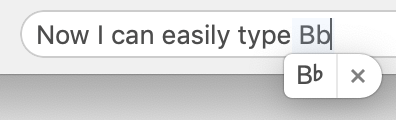
<p>Me too! Instead, I’ve programmed my sharps, flats, and natural signs to be replaced by Auto-Correct every time I type a certain sequence of keys.</p>

<h3 id="global-autocorrect">Global autocorrect</h3>

<p>If you want to be able to use these symbols quickly in any app, you can make this a global autocorrect setting throughout OSX. Go to <strong>System Preferences → Keyboard → Text</strong>, and you’ll see a table of custom text replacements. Here are the ones I use for accidentals:</p>

<table>
  <thead>
    <tr>
      <th>Replace</th>
      <th>With</th>
    </tr>
  </thead>
  <tbody>
    <tr>
      <td>!b</td>
      <td>♭</td>
    </tr>
    <tr>
      <td>!#</td>
      <td>♯ </td>
    </tr>
    <tr>
      <td>!n</td>
      <td>♮ </td>
    </tr>
  </tbody>
</table>

<p><img src="/assets/posts/typing-4.png" class="img-responsive" alt="autocorrect replacing Bb with B♭" /></p>

<p>Add those replacements, and then all you need to do is type that shortcut and your computer will replace it with nice pretty flat sign, sharp sign, or natural sign. B!b becomes B<span class="music">♭</span>. No more placeholder ‘b’s and ‘#’s!</p>

<h3 id="app-specific-autocorrect">App-specific autocorrect</h3>

<p>Word processing apps like Pages (MacOS) and Microsoft Word also have their own autocorrect dictionaries, so you can also add these text replacements there. They will then only work in that app.</p>

<h2 id="chord-symbols-and-figures">Chord symbols and figures</h2>

<p><em>You can also achieve these things by installing custom fonts, an option I’ll discuss further below. </em></p>

<p>Chord quality symbols can be quickly typed with a combination of alternate characters and superscript.</p>

<table>
  <thead>
    <tr>
      <th>Quality</th>
      <th>Symbol</th>
      <th>Keyboard shortcut</th>
    </tr>
  </thead>
  <tbody>
    <tr>
      <td>major 7 (jazz)</td>
      <td>∆</td>
      <td><kbd>⌥J</kbd> and add superscript</td>
    </tr>
    <tr>
      <td>diminished 7</td>
      <td>º</td>
      <td><kbd>⌥0</kbd> (no need for superscript)</td>
    </tr>
    <tr>
      <td>half-diminished 7</td>
      <td>ø</td>
      <td><kbd>⌥O</kbd> and add superscript</td>
    </tr>
  </tbody>
</table>

<p>A single figure is also easily achieved with superscript, as in V<sup>4–3</sup>.</p>

<p>But things get trickier when you need multiple rows of figures, for example, to show a cadential 6/4—for that, we need to start using tools for displaying mathematical equations.</p>

<h3 id="latexmathjax-web-interfaces-pages-app">LaTeX/MathJax (Web interfaces, Pages app)</h3>

<p><a href="https://www.latex-project.org/">LaTeX</a> is a super flexible tool that I honestly don’t even fully understand. <a href="https://www.mathjax.org">MathJax</a> is derived from LaTeX and allows display of LaTeX math equations on web browsers.</p>

<p>This may sound intimidating, but really, we don’t need to fully understand LaTeX in order to use it to display music theory symbols. I’m going to give you templates to copy-paste into LaTeX to generate Roman numerals with figures and scale-degree carats.</p>

<p>You can use MathJax in a lot of places: on the web (on this website, for example, and on <em><a href="http://viva.pressbooks.pub/openmusictheory">Open Music Theory</a></em>) and in word procsesors like Pages (MacOS) and Microsoft Word. Of course, if you’re hardcore, you use LaTeX</p>

<p>Anyway, here’s what you want—templates for typing music stuff.</p>

<table>
  <thead>
    <tr>
      <th>for</th>
      <th>use LaTeX code</th>
      <th>renders as</th>
    </tr>
  </thead>
  <tbody>
    <tr>
      <td>scale degrees</td>
      <td><code class="language-plaintext highlighter-rouge">\hat{x}</code></td>
      <td>$ \hat{x} $</td>
    </tr>
    <tr>
      <td>accidentals</td>
      <td><code class="language-plaintext highlighter-rouge">\flat\sharp\natural</code></td>
      <td>$\flat\sharp\natural$</td>
    </tr>
    <tr>
      <td>figures</td>
      <td><code class="language-plaintext highlighter-rouge">^x_y</code> <br /><br /><code class="language-plaintext highlighter-rouge">^{x1-x2}_{y1-y2}</code></td>
      <td>$^x_y$ <br /><br /> $^{x1-x2}_{y1-y2}$</td>
    </tr>
  </tbody>
</table>

<p>To insert these equations in Pages (MacOS) or Microsoft Word, go to <strong>Insert &gt; Equation</strong>. There, you can enter the LaTeX formulas above.</p>

<p>Sometimes I’ll write prompts on tests/quizzes in LaTeX, which just requires a little bit more effort, but pays off in beauty! The web display below has some wonkiness with the letters being offset, but this doesn’t happen in word processors.</p>

<table-saw>
<table class="table">
<thead>
<tr>
<th>LaTeX code</th>
<th>rendered</th>
</tr>
</thead>
<tbody>
<tr>
<td><code>\mathrm{C\sharp\ minor:\ V^4_3}</code></td>
<td>$\mathrm{C\sharp\\ minor:\\ V^4_3}$</td>
</tr>
</tbody>
</table>
</table-saw>

<p>(The <code class="language-plaintext highlighter-rouge">\mathrm{}</code> part makes the text regular instead of italic, an escape character <code class="language-plaintext highlighter-rouge">\</code> is necessary before any space you want to actually render, and the rest is basically self-explanatory.)</p>

<p>Another great thing about LaTeX is that it’s widely used in the sciences, which means there are a <em>ton </em>of people around who are very fluent in making things happen with LaTeX. Posting and asking for help on a forum or other social media is likely to get you a quick response.</p>

<h2 id="specialized-fonts">Specialized fonts</h2>

<p>The above solutions are cool because they should work across platforms, but sometimes a special font is just the trick to get the job done.</p>

<p>I recommend <a href="http://hindson.com.au/info/free/free-fonts-available-for-download/">the free fonts provided by Matthew Hindson</a> on his website. I’ve been using them for years, especially the <strong>Staff Clef Pitches Easy</strong> and the Rhythms font, both of which I find extremely useful for making quizzes and tests. He also provides key maps for all his fonts, so it’s easy to learn how to use them.</p>

<div class="col-lg-6 mx-auto">
<img src="/assets/posts/typing-2.png" class="img-fluid" alt="" />
<img src="/assets/posts/typing-3.png" class="img-fluid" alt="" />
</div>

<h2 id="more-questions">More questions?</h2>

<p>If you have other music theory problems you need to solve in your word processing adventures, email me—I might have another trick to share. And I’ll keep updating this post as I think of new tricks.</p>]]></content><author><name>Dr. Megan L. Lavengood</name></author><summary type="html"><![CDATA[After obsessing over typographical details in my theory papers for over 10 years, I am distilling my tricks for anyone else who might like a hand making their papers look pretty. I occasionally reference some Mac-specific things, but I’m certain there are analogous tricks for Windows machines.]]></summary></entry><entry><title type="html">Journal of Schenkerian Studies: Proving the Point</title><link href="https://meganlavengood.com/2020/07/27/journal-of-schenkerian-studies-proving-the-point/" rel="alternate" type="text/html" title="Journal of Schenkerian Studies: Proving the Point" /><published>2020-07-27T16:26:37+00:00</published><updated>2020-07-27T16:26:37+00:00</updated><id>https://meganlavengood.com/2020/07/27/journal-of-schenkerian-studies-proving-the-point</id><content type="html" xml:base="https://meganlavengood.com/2020/07/27/journal-of-schenkerian-studies-proving-the-point/"><![CDATA[<p><a href="https://twitter.com/meganlavengood/status/1287441536372932608?s=20">I wrote up a thread on Twitter</a> yesterday summarizing the worst takes in the <em><a href="https://mhte.music.unt.edu/journal-schenkerian-studies">Journal of Schenkerian Studies</a> </em>Vol. 12, which responds to <a href="https://vimeo.com/372726003">Phil Ewell’s plenary talk</a> at <a href="https://societymusictheory.org/archives/events/meeting2019">SMT 2019</a> on what he calls Music Theory’s White Racial Frame. In this blog post I want to build on that by pointing out how many of the responses raise concerns/questions that Ewell already addressed in his keynote. Instead of referencing the keynote video, which is a bit harder to navigate, I’ll use <a href="https://mtosmt.org/issues/mto.20.26.2/mto.20.26.2.ewell.html">his recent publication that is built on that talk</a>.</p>

<p>In this post I’d like to highlight what I consider one of the most egregious failings of the issue: that so many of the published critiques were already addressed by Ewell in his talk and other scholarship (and for that matter, by other scholars too). Had these comments below been given proper review, their authors might have been able to frame their comments more productively.</p>

<p>On that note, here are some of the common points made by the responses and including quotes from various authors along those lines, followed by Ewell’s own words that have preemptively addressed these critiques.</p>

<h2 id="everyones-a-little-bit-racist-schenkers-racism-as-a-product-of-its-time">Everyone’s a Little Bit Racist: Schenker’s racism as a product of its time</h2>

<p>David Beach: “I do not offer any excuses for these comments, but I do want to stress that it is important to understand the contexts under which they—at least some of them—were made.”</p>

<p>Timothy Jackson: “Schenker’s many earlier anti-French, anti-British, anti-American, and anti-Black vituperations— before, during, and after World War I—must be interpreted in the context of that war and its aftermath, in which these nations were all perceived enemies of Germany and Austria, and of German scientific racism. Furthermore, it must be recognized that racist and genocidal thinking was common among German intellectuals from the late twentieth century forward.”</p>

<p>Anonymous (yep, really, a published anonymous response in an academic journal): “That Schenker, or anyone else alive during the turn-of-the-century time period, espoused racist views is completely unremarkable. For Schenker to have not, at some point, hold those beliefs would be truly exceptional.”</p>

<p>Timothy Jackson: “German scientific racism—with genocidal implications—had become ubiquitous in German culture by the beginning of the twentieth century, and one would be hard pressed to find educated Germans at that time who remained uninfluenced. Therefore, we should not be at all surprised that some of Schenker’s earlier statements decrying racial mixture reflect this mindset…”</p>

<p>Nicholas Cook: “What we can say is that Schenker believed in some form of cultural evolutionary’theory, implying that white people represent a higher stage of human development than the ‘more primitive races’ to which he referred. Clearly we would regard that as racist today, but the fact is that such thinking is found in a great deal of writing from the high point of imperialism a century or so ago; it wasn’t exceptional, in the way that the extremity of Schenker’s political beliefs was. The difference in worldview between now and then is something we should always attend to when we engage with the writings or more generally the culture of that period.”</p>

<blockquote class="small">
  <p>Schenker’s views on race were extreme, to be sure, but he was certainly not alone. Hugo Riemann, Arnold Schoenberg, Anton Webern, and many others on whose theories we rely all believed in German—and almost certainly white—superiority. … In fact, much of how we understand race in the U.S. is part of a global western understanding of race that is, in fact, written by white persons. It is therefore unsurprising that white Schenker scholars do not point out the racialized aspects of the man and his work in the same way I do as a nonwhite. And it is exactly these nonwhite perspectives on race that are ignored or glossed over in global race theory, as described above by Heng.</p>

  <p class="figcaption">Ewell 2020, par. 4.7.1</p>
</blockquote>

<p>Unsurprisingly, Ewell is already aware that a lot of people were racist in the 19th century; the impacts of this should be scrutinized, though, and not ignored or excused.</p>

<h2 id="alllivesmatter-schenker-wasnt-just-racist-against-black-people-and-schenker-was-jewish-so">#AllLivesMatter: Schenker wasn’t just racist against Black people, and Schenker was Jewish, so.</h2>

<p>Barry Wiener: “When Japan prepared to enter World War I on the side of Great Britain, Schenker simultaneously reviled the Japanese and the English … In fact, Schenker condemned all of Germany’s enemies equally—including the English, French, Italians, and Anglo-Americans—as members of primitive races … As we have seen, for Schenker at the time, almost everyone on earth fit into the categories of ‘wild and half-wild peoples,’ and ‘primitive nations and races,” except for the Germans.’”</p>

<p>Timothy Jackson: “To be sure, the Great War provides -the essential framework within which one must interpret Schenker’s earlier anti-French, anti-British, anti-American, and also anti-Black comments in his diary and letters. Indeed, readers of Schenker’s diary cannot ignore the extent and breadth of its author’s virulent, visceral hatred of the French, a <em>white</em> race…”</p>

<p>Timothy Jackson again: “On the contrary, demagogues from the extreme right and left, Black Nationalist-and also White Nationalist-and also in academe, continue to legitimize scapegoating ‘the Jews’ for every conceivable ill. In this sense, Ewell’s denunciation of Schenker and Schenkerians may be seen as part and parcel of the much broader current of Black anti-Semitism.”</p>

<p>Nicholas Cook: “I am uncomfortable with a discussion of Schenker’s racism that doesn’t engage with the way in which racism impinged on his own life. … And we should never forget that Schenker’s wife Jeanette was sent to the Theresienstadt concentration camp in 1942 and died there in 1945; I suppose Heinrich would have shared her fate had he lived long enough. In short, Schenker knew what it was to be a member of a racially marked minority.”</p>

<blockquote class="small">
  <p>One of the main goals of our white racial frame is to take the focus off of whiteness, and one of its main methods for doing so is, if the topic turns to whiteness, to immediately invoke other marginalized groups, thereby diminishing whiteness’s role. I therefore, with this work, focus like a laser beam on whiteness and how it manifests itself in our field. I look forward to turning my attention to how our white frame intersects with all marginalized groups in the future, but for now I focus primarily on whiteness—first things first.</p>

  <p class="figcaption">Ewell 2020, par. 1.4</p>
</blockquote>

<p>Being Jewish or part of any other marginalized group does not excuse racism. Ewell notes that intersectionality is real and complex, but intersectionality isn’t meant to obviate critique of whiteness and anti-Blackness.</p>

<h2 id="youre-so-articulate-some-black-music-is-schenkable">You’re So Articulate: Some Black Music Is Schenkable</h2>

<p>David Beach: “My suggestion to Philip Ewell is that he stop complaining about us white guys and publish some sophisticated analytical graphs of works by black composers. I, for one, would welcome into the analytical canon works by both black and women composers.”</p>

<p>Jack Boss: “It seems as if Philip Ewell has portrayed Heinrich Schenker as arguing from the premise that musical works of genius build themselves out from an <em>Ursatz</em> through diminution, and reaching the conclusion that Black musicians cannot produce works of genius. [But we can use] the premises of Schenkerian analysis to lead to the opposite conclusion; that Black musicians did indeed produce works of genius, works which ornamented their structures in new and fascinating ways, and are worthy of our study.”</p>

<p>Allan Cadwallader: “I have spent my entire career involved with Schenker’s work, mostly with his theories and his analyses alone, marveling at the musical insights they can reveal about a certain repertoire. Let us expand that repertoire and celebrate diversity in scholarship and in the classroom.”</p>

<p>Timothy Jackson: “The great tradition of classical music includes Black, Jewish, and female composers, and remains, as Schenker ultimately recognized, an ‘elitism of the hearing of the spirit, not of race.’”</p>

<blockquote class="small">
  <p>The first solution the white frame will think of to solving the racial imbalance will likely be to find examples by Chevalier Saint-Georges, William Grant Still, and Scott Joplin. But stocking our textbooks with musical examples by these black composers is not the solution to this problem, which is a result of framing western functional tonality as the only organizational force in music worthy of music theory’s consideration in the music-theory classroom. … The fact that many of the ideas from functional tonality appear in so many of the world’s musics is a direct result of the power of colonialism and hegemony. Thus, the problem of our white frame in our music curricula concerns not only the repertoire that we study, but also the music theories behind the repertoire.”</p>

  <p class="figcaption">Ewell 2020, par. 3.4</p>
</blockquote>

<p>Ewell says that it’s not enough, or even really a solution, to make an effort to include Black musicians if we are still operating within a curriculum/methodology that is built to support white musicians first.</p>

<h2 id="ok-fine-schenker-was-racist-but-his-theories-definitely-have-nothing-to-do-with-that-so-were-good-to-go-here">OK fine, Schenker was racist, but his theories definitely have nothing to do with that, so we’re good to go here</h2>

<p>Barry Wiener: “While for Schenker, theory and musicology are tightly connected, there is no obvious connection between his politics and his musical ideas, other than the idea that some composers apply the laws of art in more creative ways than others.”</p>

<p>Steven Slottow: “Schenker may have believed at some points in the evolution of his thought that his various political and racial beliefs were indistinguishable from his music theory and analytical methodology, but his successors haven’t agreed, finding something very valuable in the latter but not in the former.”</p>

<p>Boyd Pomeroy: “The facts are not seriously in question: Schenker was a deeply flawed and conflicted character whose virulently nationalist and racist views are unpalatable by any standards. … But what of Ewell’s evidence for his claim of racism’s foundational role in the theory itself? It is, to put it mildly, flimsy.”</p>

<p>Rich Pellegrin: “Hierarchy is natural, often a matter of life and death, and is in and all around us—from the fractal, branching structures of our circulatory and nervous systems to those of rivers and snowflakes; from networks of paths and roadways to electrical, plumbing, and delivery systems; and from rhythm and meter in tonal music to harmony and voice leading. It is only in social and political systems that hierarchy becomes oppressive, due to the human capacity for abuse of power.”</p>

<p>Timothy Jackson: “Ewell argues, probably correctly, that Schenker would have objected [to moving his racist views to appendices rather than including them in the main text of <em>Free Composition</em>]. However, it is indeed possible—even desirable—to separate the technical musical-analytical aspects of Schenker’s theory from most of his philosophical, political, and aesthetic claims…”</p>

<p>Allan Cadwallader: “My point is that Schenker was a practical theorist who drew upon practical musical ideas from the past. To espouse their principles, and the repertoire from which they are drawn, is at worst exclusionary, not racist. I believe that John Rothgeb was correct in asserting that Schenker’s musical thought is ‘not at all dependent on any of his extra-musical speculations,’ despite what Schenker himself might have believed.”</p>

<p>Charles Burkhardt: “[Ewell] is quite right to deplore Schenker’s racism, but goes way over the top when he equates Schenker’s ideas on the inequality of the races with his statement on the inequality of the tones of the scale, and, likewise, equates white control over blacks with the Urlinie’s control of the subsequent structural levels. This is to confuse apples with oranges to an extreme degree. If Schenker actually believed such nonsense, he was simply wrong (and not for the first time).”</p>

<p>David Beach: “[Ewell] states that Schenker’s anti-black racism informed his theory. This is simply not correct. Schenker developed his ideas about musical structure by studying the music of the great masters (indeed a group of white guys!), and one of the bases of his criticism of music he considered inferior was that they lack what he had observed in the ‘masterworks.’ .So, his views on black music did not inform his theory; rather it was his theory that led him to view the music of other cultures as lacking.”</p>

<p>I feel that Ewell’s entire talk/essay is about the inseparability of racism from music theory, so allow me to quote several passages.</p>

<blockquote class="small">
  <p>Colorblind racism is the most significant form of racism in music theory’s white racial frame and has been used for decades to dismiss those who wish to cite our racialized structures and ideologies. “What do music and music theory have to do with race?” is a common colorblind refrain, which accomplishes two goals: it allows for music theory’s white-framed theorist to appear to be on the right side of racism, while allowing the very same racialized structures, put in place to benefit white persons, to remain foundational in the field without appearing racist.</p>

  <p class="figcaption">Ewell 2020, par. 2.3</p>
</blockquote>

<blockquote class="small">
  <p>One of music theory’s greatest feats is its ability to sever its own past from the present. If some historical aspect of a theory is unseemly or unsavory, we typically bury it, and move on. What, after all, do political, social, and cultural attitudes have to do with the content of someone’s underlying theoretical thought? … To put this another way, to consider these theories ahistorically is to surgically remove all traces of racism, insofar as racist strains do nothing to advance the theories in question, all of which allows the white racial frame music theorist to reside in a music-theoretical Witness Protection Program, never to be held accountable with respect to the difficult questions concerning race and whiteness.</p>

  <p class="figcaption">Ewell 2020, par. 4.1.3</p>
</blockquote>

<blockquote class="small">
  <p>[Nicholas] Cook, in a parenthetical comment, makes it clear that he believes linking Schenker’s racism to his musical theories is unhelpful … What Cook means to say here is that it is unhelpful insofar as it calls attention to race—that is, unhelpful to music theory’s white racial frame. I, however, happen to think it is extremely helpful, in terms of understanding how we deal with race in music theory, to draw this ‘obvious parallel.’ Finally, I point out that Cook’s comment corresponds directly to white-frame belief that it would be inappropriate to critically examine race in music theory.”</p>

  <p class="figcaption">Ewell 2020, 4.3.4</p>
</blockquote>

<p>The respondents claiming that we can easily detach racism from theory seem to be willfully deluding themselves and ignoring what Ewell said in the first place.</p>

<h2 id="wake-up">Wake up.</h2>

<p>These responses are written by people with phds and long careers in the humanities, yet they have allowed themselves to remain blind to some of the most obvious problems with their claim. I am disappointed with several of these scholars for refusing to apply the critical thinking and nuance they use every day in their teaching and research to something as important as these issues are. In 2020, they should do better. I’m infuriated (but not really surprised) that our current climate of hyperawareness toward race in academia and in broader US society seems not to have prompted these scholars to reflect on their own participation in the white racial framing of our field.</p>

<p>If any of these scholars happen to read this blog post someday: please, reread Ewell’s article, and find your own arguments rebutted in it. You need to engage with those rebuttals in order to have responsibly held up your side of the bargain in this “scholarly exchange” (such as it is). Read some critical race theory. If you believe in anti-racism in other aspects of life, such as policing, housing, etc., try applying that to music theory too. Reflect on how Schenker’s own framing and our acceptance of it might lead to this issue and the entire journal’s editorial board being entirely white men plus one white woman (as far as I can tell; I could be mistaken); to Schenkerian conference programs and bibliographies being dominated by white men; to the music we spend time with and care about the most to be dominated by white men. Consider that maybe your defensive reaction comes more from personal pride and discomfort, rather than something more objective. Our growth as a field depends on our ability to critically self-reflect.</p>]]></content><author><name>Dr. Megan L. Lavengood</name></author><summary type="html"><![CDATA[I wrote up a thread on Twitter yesterday summarizing the worst takes in the Journal of Schenkerian Studies Vol. 12, which responds to Phil Ewell’s plenary talk at SMT 2019 on what he calls Music Theory’s White Racial Frame. In this blog post I want to build on that by pointing out how many of the responses raise concerns/questions that Ewell already addressed in his keynote. Instead of referencing the keynote video, which is a bit harder to navigate, I’ll use his recent publication that is built on that talk.]]></summary></entry></feed>